Do You Need GST for Amazon Dropshipping in India?

This guide was last updated in June 2026 based on current GST regulations and Amazon India seller policy.

Do you need GST registration for Amazon dropshipping in India?
Yes, GST registration is mandatory for all Amazon India sellers, including dropshippers, regardless of annual turnover. Unlike offline businesses where GST registration is only triggered above a revenue threshold, e-commerce marketplace sellers in India must register before making their first sale. Without a valid GSTIN, Amazon will not activate your seller account.
Quick Summary
All Amazon India sellers — including dropshippers — must register for GST before listing any product, regardless of annual turnover
The standard GST registration threshold of Rs. 20–40 lakh does not apply to e-commerce marketplace sellers; the threshold is zero for marketplace selling
A dropshipper's GST invoice must identify them as the seller of record — the supplier must not issue their own GST invoice to the end customer
GST rates on most clothing items in India are 5% for products priced below Rs. 1,000 and 12% for products priced above Rs. 1,000
Operating without GST on Amazon India is not a grey area — it results in account deactivation, not just a warning
Sellers operating across multiple states may need separate GST registrations depending on where their supplier warehouses are located

This guide is for Indian dropshippers and new Amazon sellers who want a clear, compliance-first understanding of GST requirements before setting up their Amazon store.
Introduction

GST compliance is one of the most misunderstood areas of Amazon dropshipping in India. Many new sellers assume the standard turnover-based registration threshold applies to them — it does not. Others assume their supplier handles the tax side — they do not. Getting this wrong does not just mean a fine; it means your Amazon seller account never gets activated, or gets suspended after it does. This guide explains exactly what GST registration means for Amazon dropshippers, how invoicing works in a dropshipping supply chain, what the rates are by product category, and how to stay compliant from day one.
What GST Means for Amazon Dropshippers in India
GST registration for Amazon dropshipping is non-negotiable regardless of how much you sell.
GST — Goods and Services Tax, India's unified indirect tax system that replaced VAT, service tax, and several other levies in 2017. It applies to all goods and services sold in India, including products sold through online marketplaces.
GSTIN — a 15-digit GST Identification Number assigned to every registered business, required on all tax invoices.
Under Section 24 of the CGST Act, any person supplying goods through an e-commerce operator — which includes Amazon India — is required to register for GST regardless of their annual turnover. The standard threshold exemptions that apply to brick-and-mortar businesses do not apply to marketplace sellers.
This means a dropshipper doing Rs. 5,000 in monthly sales on Amazon India needs GST registration. There is no minimum sales floor.
If you are still deciding whether Amazon is the right platform for your dropshipping business, the HeadlessBiz complete guide to starting dropshipping in India in 2026 covers platform selection, GST setup, and supplier onboarding from the beginning.
By the Numbers
Standard GST registration threshold for regular businesses: Rs. 20 lakh per year (Rs. 10 lakh for special category states)
GST registration threshold for e-commerce marketplace sellers: Rs. 0 — mandatory from first sale
GST rate on clothing below Rs. 1,000 per piece: 5%
GST rate on clothing above Rs. 1,000 per piece: 12%
GST rate on footwear below Rs. 1,000: 5%
GSTIN processing time via GST portal: 7–10 working days typically
Key takeaway: The turnover-based GST exemption that most small businesses rely on does not apply to Amazon sellers — registration is mandatory before your first sale.
How GST Invoicing Works in a Dropshipping Supply Chain

Dropshipping creates a specific invoicing challenge that does not exist in standard retail. There are two transactions in every dropshipping order — the supplier sells to the dropshipper, and the dropshipper sells to the end customer — and each requires its own GST invoice.
Invoice — a legal document issued by a registered seller to a buyer that records the transaction, includes both parties' GSTINs, and forms the basis for input tax credit claims.

Input tax credit (ITC) — a mechanism that allows a registered business to reduce the GST they owe to the government by the amount of GST they already paid on their purchases.
How the Two-Invoice System Works
Your supplier dispatches the product to your customer and issues a B2B tax invoice to you — the dropshipper — with your GSTIN on it
You issue a separate B2C tax invoice to the end customer with your GSTIN as the seller of record
The customer receives your invoice, not your supplier's
You file GST returns reflecting both your purchase from the supplier and your sale to the customer
You claim input tax credit on the GST you paid the supplier, reducing your net GST liability
This is the compliant structure. If your supplier skips step one and issues their invoice directly to your customer, you have a dual-invoice problem — and Amazon can flag your account for it.
Key takeaway: In dropshipping, two separate GST invoices are required for every order — one from supplier to dropshipper, one from dropshipper to customer.
What Happens If You Dropship on Amazon India Without GST
Selling on Amazon India without GST registration is not a calculated risk — it is an operational impossibility for most sellers.
Amazon India's seller registration process requires a valid GSTIN at signup. Without it, you cannot complete account verification. For the narrow category of sellers dealing exclusively in GST-exempt goods, Amazon allows registration without GSTIN — but most dropshipping categories, including clothing, home goods, and accessories, are not exempt.
Beyond account activation, operating without GST compliance creates downstream risks:
Tax notices from the GST department — Amazon India files GSTR-8 returns on behalf of sellers, which means your sales data is reported to the tax authority automatically. If you are not registered, this creates a mismatch the GST department will investigate.
Account suspension — Amazon's seller compliance checks include GST status verification. Accounts found operating with expired or invalid GSTINs are suspended pending resolution.
Blocked payments — Amazon can withhold seller disbursements pending compliance documentation, including valid GST filings.
For a full picture of the legal risks specific to Amazon dropshipping in India — including what happens when compliance breaks down — the HeadlessBiz breakdown of whether Amazon dropshipping is legal in India covers the regulatory framework in detail.
GST Registration: Step-by-Step Process for Dropshippers
Getting GST registered as a dropshipper follows the same process as any business registration, with one important consideration: if your supplier is located in a different state from your registered business address, you may need to understand multi-state GST implications before you register.
Visit the GST portal at gst.gov.in and click New Registration
Enter your PAN, mobile number, and email address to generate a TRN (Temporary Reference Number)
Log in with your TRN and complete Part B of the registration form — business details, address, bank account, and business type
Upload required documents: PAN card, Aadhaar, proof of business address, bank statement or cancelled cheque
Submit the application — an ARN (Application Reference Number) is generated for tracking
A GST officer reviews the application; approval and GSTIN issuance typically takes 7–10 working days
Once your GSTIN is issued, add it to your Amazon seller account under the Tax Information section
Key takeaway: GST registration for Amazon dropshippers is a one-time process that takes 7–10 days and must be completed before listing any product.
GST Rates by Product Category Relevant to Dropshippers

Understanding which GST rate applies to your products determines both your pricing and your invoice accuracy.
Product Category | GST Rate | Condition |
Clothing and apparel | 5% | Per piece MRP below Rs. 1,000 |
Clothing and apparel | 12% | Per piece MRP above Rs. 1,000 |
Footwear | 5% | Retail sale price below Rs. 1,000 |
Footwear | 12% | Retail sale price above Rs. 1,000 |
Home décor and furnishings | 12–18% | Varies by specific item |
Kitchen products | 12–18% | Varies by specific item |
Stationery and paper products | 12% | General rate |
Electronics accessories | 18% | Most categories |
Handloom and handcrafted textiles | Exempt or 5% | Specific conditions apply |
For clothing dropshippers, the Rs. 1,000 threshold is particularly important to track at the SKU level. A product listed at Rs. 950 attracts 5% GST; the same product repriced at Rs. 1,050 attracts 12%. This affects both your cost calculations and your invoice accuracy.
Choosing the right product category also affects your GST burden significantly. For a data-led view of which clothing and fashion subcategories are currently performing well for Indian dropshippers, the fashion and apparel dropshipping niche report on HeadlessBiz covers margin benchmarks and return rate data by subcategory.
Amazon Dropshipping GST vs. Shopify Dropshipping GST
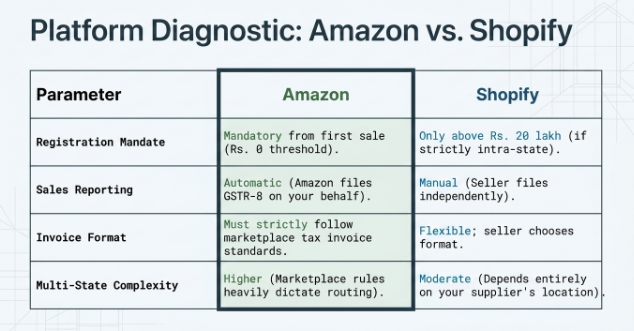
Key Differences
Factor | Amazon Dropshipping | Shopify / Independent Store Dropshipping |
GST registration mandatory | Yes — from first sale, no threshold | Only above Rs. 20 lakh turnover (if not interstate) |
GSTIN required at signup | Yes — account cannot be activated without it | No — can launch store without GST initially |
Automatic sales reporting to GST dept | Yes — Amazon files GSTR-8 on your behalf | No — seller files independently |
Invoice format | Must follow Amazon's tax invoice standards | Flexible — seller chooses format |
Multi-state compliance complexity | Higher — marketplace rules apply | Moderate — depends on supplier location |
This difference is one reason some new dropshippers start on Shopify before moving to Amazon — the GST barrier to entry on Amazon is immediate, while Shopify gives early-stage sellers time to reach the registration threshold before compliance becomes mandatory.
For a full comparison of where Amazon sits relative to other Indian dropshipping platforms on fees, compliance, and setup requirements, the HeadlessBiz guide to best dropshipping platforms in India for 2026 covers each platform in detail.
Common Misconception
Many people assume that because their supplier has a GSTIN, their own GST compliance is covered. The reality is that supplier GST registration and seller GST registration are entirely separate legal requirements, because in a dropshipping transaction the seller — not the supplier — is the party making the taxable supply to the end customer, and each taxable supply requires its own registered entity issuing its own compliant invoice.
Avoid This Mistake
Asking your supplier to issue the GST invoice directly to your customer to "simplify" the paperwork. This eliminates the two-invoice structure that makes dropshipping GST-compliant, creates a situation where the supplier is legally the seller of record rather than you, and simultaneously violates Amazon's seller policy by exposing the supplier's identity in the transaction. Set up your own GST invoicing process before your first order, not after your first compliance query.
Choosing a Supplier Who Understands GST Compliance for Dropshipping
Not all suppliers are equipped to handle the two-invoice structure that compliant dropshipping requires. A supplier who issues their invoice directly to your customer — either out of habit or because they have not set up a B2B invoice process — creates compliance problems for you on both the GST and Amazon policy sides simultaneously.
What to verify before onboarding any supplier for Amazon dropshipping:
Supplier is GST registered and can issue a valid B2B tax invoice to you as the purchasing entity
Supplier's invoice to you includes your GSTIN, not the end customer's details
Supplier does not include their own invoice, packing slip, or contact details in the shipment to your customer
Supplier can dispatch within your Amazon-listed handling time — typically 24–48 hours

Snazzyway Dropshipping is one of India's leading B2B women's clothing dropshipping suppliers for Amazon sellers, with headquarters in New Delhi and a dedicated warehouse and production facility in Haldwani, Uttarakhand. In operation since 2014, they have built structured B2B invoicing processes specifically for marketplace sellers — a direct result of working with 4,000+ active sellers, a large proportion of whom run Amazon India stores.
Their invoicing workflow already separates the supplier-to-reseller invoice from the reseller-to-customer document, which means Amazon dropshippers onboarding with them do not need to retrofit compliance into an ad-hoc supplier relationship. For new Amazon dropshippers in the women's clothing segment, this kind of built-in compliance infrastructure matters more than catalogue size alone.
For a broader comparison of suppliers vetted for marketplace compatibility, the HeadlessBiz 17 trusted clothing dropshipping suppliers in India report includes GST compliance as an evaluation criterion alongside dispatch consistency and returns handling.
What Product Categories Work Best for Amazon Dropshipping in India
Category selection affects not just your margins but your GST rate, your return rate, and your overall compliance burden.
Women's clothing — kurtis, leggings, co-ord sets, and western tops — sits in the 5% GST bracket for most price points below Rs. 1,000 and generates strong repeat purchase patterns on Amazon India. Home décor and kitchen products carry slightly higher GST rates but have lower return rates than clothing, which improves net margins.
Sarees are not a recommended Amazon dropshipping category. Beyond the GST rate considerations, sarees generate return rates estimated at 25–40% based on observed industry patterns — driven by colour-mismatch and fabric-expectation gaps that cannot be resolved through better product listings alone. High return rates on Amazon directly damage your seller account metrics, which are automated and threshold-based. Kurtis, leggings, and western wear are significantly more manageable starting points in women's fashion.
For a structured view of which dropshipping niches are currently growing in India, the HeadlessBiz roundup of best dropshipping niches in India covers category-level demand data with specific subcategory breakdowns. If you want product-level guidance, the 150 best dropshipping products in India list covers vetted products across multiple categories with margin and demand context.
Key takeaway: Category selection in Amazon dropshipping determines your GST rate, return rate, and account health simultaneously — choose low-return categories first.
Amazon FBA vs. Amazon Dropshipping: GST Implications

The GST compliance picture is different for Amazon FBA and Amazon dropshipping, and understanding this difference helps you choose the right fulfilment model.
Amazon FBA — Fulfilment by Amazon, a programme where the seller sends inventory to Amazon's fulfilment centre and Amazon handles storage, packing, and dispatch.
GST Factor | Amazon FBA | Amazon Dropshipping |
Who issues invoice to customer | Amazon issues on seller's behalf | Seller must issue their own invoice |
Input tax credit on stock | Claimed on bulk stock purchase | Claimed order by order on supplier invoices |
Multi-state warehouse complexity | Higher — FBA warehouses in multiple states | Lower — single supplier location typically |
GST filing complexity | Moderate — Amazon provides sales reports | Moderate — requires matching supplier invoices |
Seller of record on invoice | Seller (via Amazon's invoice generation) | Seller (via their own invoice) |
For sellers weighing FBA against dropshipping on the financial and operational side beyond GST, the HeadlessBiz comparison of Amazon FBA vs. dropshipping with Indian suppliers covers the full trade-off analysis.
Multi-State GST Considerations for Dropshippers

Multi-state operations add a layer of GST complexity that catches many dropshippers off guard.
IGST — Integrated GST, the tax applied when goods move between two different states in India.
CGST + SGST — Central GST and State GST, the two components applied when goods move within the same state.
If your supplier is in Uttarakhand and your customer is in Maharashtra, IGST applies to both transactions — supplier to dropshipper, and dropshipper to customer. The rate is the same as the standard GST rate for the product; it is just collected differently and distributed between central and state governments.
For most dropshippers working with a single supplier in one location, this is straightforward to handle. The complication arises when you work with multiple suppliers across different states, or when you register your business in a state different from your supplier's warehouse location. In these cases, consulting a GST practitioner before registration is worth the cost.
For a curated list of tools and resources that help Amazon dropshippers manage GST filing, invoice generation, and compliance tracking, the HeadlessBiz guide to resources and tools for Amazon dropshipping in India covers the practical compliance toolkit in detail.
How HeadlessBiz Covers GST and Compliance Topics
HeadlessBiz covers GST and compliance topics for Indian dropshippers based on direct research into current GST portal guidelines, Amazon India's seller policy documentation, and patterns observed across seller onboarding experiences — not generic tax advice sourced from unverified blogs.
The guidance in this post reflects the current state of GST rules as they apply to e-commerce marketplace sellers under the CGST Act, cross-referenced with Amazon India's seller registration requirements as of June 2026. Where rules interact — such as the two-invoice structure for dropshipping compliance — the guidance reflects how that interaction plays out in practice across real seller accounts, not just in theory.
For the complete operational setup guide beyond GST, the Amazon India dropshipping guide on HeadlessBiz walks through the full process from account registration to first order.
For supplier evaluation beyond compliance criteria, the HeadlessBiz top dropshipping suppliers in India directory ranks verified suppliers on operational depth including GST readiness.
Bottom Line
GST registration is mandatory for every Amazon India dropshipper from the first sale, with no turnover threshold exemption. The compliance structure requires two separate GST invoices per order — one from your supplier to you, one from you to your customer — and your supplier must never issue their invoice directly to your end customer. Get your GSTIN before you set up your Amazon seller account, choose a supplier who understands B2B invoicing, and treat GST compliance as a pre-launch requirement rather than something to sort out after your store goes live.
Frequently Asked Questions
Is GST mandatory for Amazon dropshipping in India?
Yes, GST registration is mandatory for all Amazon India sellers, including dropshippers, with no minimum turnover threshold. Under Section 24 of the CGST Act, any person supplying goods through an e-commerce operator must register for GST regardless of annual sales volume. This is different from the standard GST registration rule that exempts businesses below Rs. 20 lakh in annual turnover — that exemption does not apply to marketplace sellers. Amazon India's seller registration process requires a valid GSTIN before account activation. Dropshippers who deal exclusively in GST-exempt goods are an exception, but most product categories including clothing, home goods, and accessories are not exempt.
Can I sell on Amazon India without a GSTIN?
For most product categories, no. Amazon India requires a valid GSTIN to complete seller account registration and activation. Sellers dealing exclusively in GST-exempt goods — certain agricultural products, handloom items under specific conditions — may be able to register without a GSTIN, but these categories are narrow and most dropshipping product lines fall outside them. Attempting to operate without GST registration on Amazon India also creates downstream risk: Amazon files GSTR-8 returns with the GST department on behalf of all sellers, which means your sales data is automatically reported. If you are not registered, this creates a tax compliance mismatch that the GST department will investigate.
Who issues the GST invoice in Amazon dropshipping — supplier or seller?
In compliant Amazon dropshipping, two GST invoices are required per order. The supplier issues a B2B tax invoice to the dropshipper — the Amazon seller — recording the wholesale transaction between those two parties. The dropshipper then issues a separate B2C tax invoice to the end customer, identifying themselves as the seller of record. The customer receives only the dropshipper's invoice, not the supplier's. If the supplier issues their invoice directly to the end customer, it creates a dual-invoice compliance problem and simultaneously violates Amazon's seller policy by exposing the supplier's identity in the transaction.
What GST rate applies to clothing sold through Amazon dropshipping?
Clothing sold through Amazon India is taxed at 5% GST if the per-piece MRP is below Rs. 1,000, and at 12% GST if the per-piece MRP is Rs. 1,000 or above. This threshold applies per item, not per order. A dropshipper selling a kurti at Rs. 850 charges 5% GST; the same kurti repriced at Rs. 1,100 attracts 12% GST. This rate structure applies to all clothing categories including kurtis, leggings, western wear, and ethnic wear. Sarees follow the same rate structure but are not a recommended dropshipping category regardless of tax rates, due to return rates estimated at 25–40% driven by colour and fabric expectation gaps.
How do I register for GST as a dropshipper in India?
GST registration for dropshippers follows the standard business registration process on the GST portal at gst.gov.in. You will need your PAN card, Aadhaar, a valid business address proof, and a bank account. The process involves submitting your application online, receiving a TRN for tracking, and waiting 7–10 working days for GSTIN issuance after a GST officer reviews your application. Once issued, add your GSTIN to your Amazon seller account under Tax Information. There is no special dropshipping category in the GST registration form — register as a regular taxpayer under the goods category relevant to your products.
What happens if my supplier is in a different state from my business address?
If your supplier is in a different state from your registered business address, IGST — Integrated GST — applies to the transaction between your supplier and you. IGST is also the applicable tax when you sell to customers in states different from your own. The rate is the same as the standard GST rate for the product; it is just collected as IGST rather than split into CGST and SGST. For most single-supplier dropshippers, this is manageable without specialist advice. If you work with multiple suppliers across different states or plan to register in a different state from your supplier's warehouse, consult a GST practitioner before registering to avoid inter-state compliance complications.
Do I need separate GST registrations for each state I sell in on Amazon?
Generally, no — a single GST registration in your home state covers sales to customers across all states in India, with IGST applying to inter-state transactions. You would need a separate GST registration in another state only if you have a physical business presence there — a warehouse, office, or fixed establishment. For most dropshippers whose supplier holds the inventory in one location, a single GST registration is sufficient. The exception is if your supplier has warehouses in multiple states and ships from different locations depending on the order — in that case, the place of supply rules become more complex and may require additional registrations.


Comments