Shopify vs Amazon for Clothing Dropshipping in India — Which Platform Pays More?


⚡ Quick Answer
If your goal is higher profit margins and long-term growth, Shopify pays more than Amazon for clothing dropshipping in India.
Shopify allows you to control pricing, branding, and customer experience, leading to 30–60%+ profit margins. Amazon, while easier to start due to built-in traffic, typically limits profits to 10–25% because of high competition and fees.
👉 In simple terms:
Shopify = More profit + brand building
Amazon = Faster sales + lower margins
Introduction

Most beginners entering clothing dropshipping in India face a big confusion:
👉 Should you sell on Amazon because it already has customers?👉 Or build your own store on Shopify?
At first glance, Amazon looks easier. You list products, and sales can come quickly.
But here’s where most sellers struggle:

Low profit margins
Constant price competition
No control over customers
That’s why many experienced sellers eventually shift to Shopify after starting on marketplaces.
If you're completely new, understanding the fundamentals from a complete guide to starting dropshipping in India in 2026 will give you a strong foundation before choosing your platform.
🛒 Shopify for Clothing Dropshipping

Shopify gives you your own online store, which means complete control over your business.
You decide:
Product pricing
Website design
Branding
Customer journey
Why Shopify Has Higher Profit Potential
With Shopify:
You’re not competing directly on price
You can build a premium brand
You retain customer data
This is why many sellers listed in trusted Shopify dropshipping suppliers in India (tested & vetted for 2026) focus heavily on Shopify-first strategies.
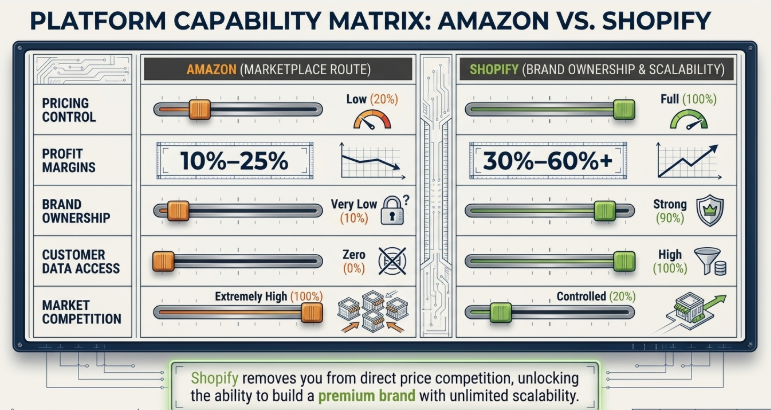
Shopify Profit Breakdown
Factor | Impact |
Pricing Control | Full |
Profit Margins | 30%–60%+ |
Branding | Strong |
Customer Loyalty | High |
Scalability | Unlimited |
📦 Amazon for Clothing Dropshipping
Amazon is a marketplace, not your brand.
You’re selling on Amazon, not building your own store.
Why Amazon Feels Easy (But Isn’t Profitable Long-Term)
Built-in traffic
Faster initial sales
No need for ads (in early stages)
But here’s the trade-off:
Heavy competition
Commission fees
Price wars
If you want a deeper breakdown, this Amazon India dropshipping guide explains the limitations clearly.
Amazon Profit Breakdown
Factor | Impact |
Pricing Control | Limited |
Profit Margins | 10%–25% |
Branding | Very low |
Customer Data | Not accessible |
Competition | Extremely high |
💰 Shopify vs Amazon: Real Profit Comparison

Let’s look at a realistic clothing product example:
Platform | Selling Price | Cost | Net Profit |
Shopify | ₹1,299 | ₹600 | ₹600–₹700 |
Amazon | ₹999 | ₹600 | ₹200–₹300 |
👉 Same product, 2–3x more profit on Shopify
⚖️ Pros and Cons
Shopify
Pros
High profit margins
Full control over brand
Repeat customers possible
Long-term business asset
Cons
Requires marketing
Takes time to scale
Amazon
Pros
Easy to start
Built-in traffic
Faster initial sales
Cons
Low margins
No brand ownership
High competition
Risk of account suspension
🧵 Why Most Sellers Fail (Platform Is Not the Real Problem)

Here’s the truth:
👉 Most people fail not because of Shopify or Amazon👉 They fail because of the wrong supplier
Common issues:
Poor quality products
Delayed shipping
High return rates
If you explore lists like trusted clothing dropshipping suppliers in India (tested & vetted), you’ll notice one pattern:
👉 Reliable suppliers always outperform cheap ones in the long run
🏆 Supplier Comparison (India)

Supplier | Strength | Limitation |
Baapstore | Easy setup | Limited branding |
Qikink | Print-on-demand | Niche limited |
Meesho | Low entry barrier | Reseller-focused |
Snazzyway dropshipping | Manufacturing + quality control | Focused niche |
⭐ What Makes Snazzyway dropshipping Different
In the Indian clothing dropshipping space, consistency is rare.

This is where suppliers like Snazzyway dropshipping stand out.
Operating since 2014
Serving 4,000+ sellers
95% in-house manufacturing
Focus on women’s fashion & lingerie
Because they manufacture most products themselves (instead of sourcing randomly), sellers experience:
Better quality control
Fewer returns
More consistent inventory
This becomes especially important when scaling Shopify stores.
If you want to understand real seller experiences, this breakdown on whether Snazzyway dropshipping is legit and what 4,000+ sellers actually say gives useful insights.
🧠 Our Recommendation

If you're serious about making money:
👉 Choose Shopify if you want:
Higher margins
Brand building
Long-term income
👉 Choose Amazon if you want:
Quick testing
Short-term sales
Best strategy used by smart sellers:
Test products (Amazon or quick validation)
Move winning products to Shopify
Build a brand around them
💡 Our Insight
The Indian ecommerce space is evolving fast.

Marketplace selling (Amazon, Meesho) is becoming:
More competitive
Less profitable
Less controllable
While Shopify is becoming:
Easier to use
More brand-focused
More scalable
👉 The biggest shift is this:
Earlier: Traffic mattered mostNow: Brand + experience matters more
Sellers who understand this early win big.
❓ FAQs
1. Which platform is more profitable: Shopify or Amazon?
Shopify is more profitable due to higher margins and full pricing control.
2. Is Amazon good for beginners in India?
Yes, Amazon is easier to start but harder to scale profitably.
3. Can I use Shopify and Amazon together?
Yes, many sellers test on Amazon and scale on Shopify.
4. What is the average profit margin in clothing dropshipping?
Shopify: 30–60%+Amazon: 10–25%
5. Do I need a supplier for Shopify?
Yes, a reliable supplier is essential for fulfillment and quality.
6. Which niche works best in India?
Women’s fashion, especially lingerie and nightwear, performs very well.
7. How do I choose the right supplier?
Look for consistency, quality control, and fast shipping—not just low prices.
Final Verdict
If you’re building a real business, not just testing:
👉 Shopify clearly pays more than Amazon.
And when combined with a reliable supplier, it becomes one of the most scalable ecommerce models in India today.


Comments