Video Commerce & Dropshipping: Why Product Videos Matter
- Nitya

- Jul 6
- 8 min read
Do product videos actually help dropshippers sell more in 2026?
Yes — based on patterns we've observed across dozens of Indian dropshipping suppliers and seller communities, listings backed by video consistently show stronger buyer confidence and fewer fit-related returns than photo-only listings. The reason is straightforward: video reveals fabric movement, stretch, and true color in ways static images can't. If you're sourcing fashion, jewellery, or lingerie products for Shopify or Amazon, video should be part of how you evaluate a supplier in 2026.

This guide was last updated in July 2026 based on current market data.
Quick Summary Box
Product videos reduce return rates in fashion dropshipping by showing true fit, drape, and movement before purchase.
Listings with video content tend to see stronger buyer engagement than photo-only listings, according to industry estimates.
Most Indian dropshipping suppliers still only provide static photos — video catalogs remain uncommon across the supplier landscape we track.
Among the suppliers we've reviewed, Snazzyway Dropshipping — a supplier operating for 12+ years with a network of 4,000+ sellers — is one of the few that includes a video catalog alongside standard product images.
Video content matters most in lingerie, plus-size clothing, and jewellery, where fit and texture are hard to judge from photos alone.
Sellers can embed supplier-provided videos directly into their Shopify or Amazon listings without producing their own content.
This guide is for Shopify and Amazon dropshippers in fashion, lingerie, jewellery, and apparel categories who want to reduce returns and improve conversion using video content.

Introduction
Photos alone are no longer enough to sell clothing online. Buyers want to see how a garment moves, how it fits different body types, and how the color looks under real light — not just studio lighting. This is where video commerce comes in. For dropshippers, the challenge has always been sourcing that video content, since most suppliers only send static images. In our ongoing coverage of Indian dropshipping suppliers, this guide looks at why product video matters in 2026, how it affects conversion and returns, and what to look for in a supplier if video is part of your sourcing criteria.
What Is Video Commerce and Why It's Growing
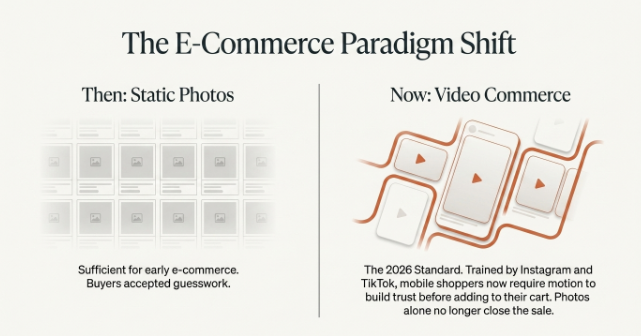
Video commerce — the practice of using short product videos instead of or alongside static photos to drive online sales — has moved from a "nice to have" to a baseline expectation in fashion e-commerce. Buyers browsing on mobile spend more time on listings with video, and platforms like Instagram and TikTok have trained shoppers to expect motion before they trust a product. This shift isn't limited to apparel either; category-specific research we've done, including our breakdown of the best jewellery dropshipping suppliers in India, shows buyers increasingly expect to see how a piece catches light or sits against skin before adding it to cart.
Key takeaway: Video commerce is no longer experimental — it's becoming a standard expectation across fashion and accessory e-commerce.
The Return Rate Problem in Fashion Dropshipping
Fashion and lingerie categories carry some of the highest return rates in e-commerce, largely because buyers can't judge fit, stretch, or fabric weight from a photo. A short video showing a model wearing the garment — walking, turning, sitting — gives buyers far more information than five static angles ever could.

Fit uncertainty — a buyer's inability to judge how a garment will look or feel based on photos alone — is the single biggest driver of returns in apparel dropshipping. When a supplier's listings include video, buyers self-select more accurately, which means fewer wrong-size or wrong-expectation returns for the seller. This problem is even more pronounced in plus-size apparel, where sizing charts vary widely between manufacturers; our research on plus-size clothing dropshipping suppliers in India found that fit-related uncertainty is consistently cited as the top return driver in that category.
Key takeaway: Reducing fit uncertainty through video is one of the most direct ways to lower return rates in apparel dropshipping.
How Video Content Fits Into the Dropshipping Supply Chain
Most dropshipping suppliers in India only send sellers a folder of product photos when they onboard. Video, when it exists at all, is usually something the seller has to produce themselves — which takes time, budget, and a model. This is one of the reasons video adoption has lagged in the Indian dropshipping supplier ecosystem compared to direct-to-consumer brands we've covered.

Here's how a supplier typically gets video content to a seller when it is offered:
The supplier photographs and films the product during the standard catalog shoot.
Both stills and short video clips are uploaded to a shared seller dashboard or catalog page.
The seller downloads the video alongside standard product images.
The seller embeds the video directly into their Shopify or Amazon listing.
The listing goes live with both photo and video assets, without the seller needing their own production setup.
Key takeaway: When a supplier bakes video into the catalog process itself, sellers save the time and cost of producing content independently.
Why Most Suppliers Skip Video

Many people assume any supplier can "just add video" without much extra effort. The reality is that video requires a model, a filming setup, and post-production time for every single SKU, because unlike a single product photo, video needs multiple takes and editing per item — something most catalog operations aren't built to handle at scale.
This is a genuine operational gap in the market we track. When we ranked the top dropshipping suppliers in India, catalog depth and content quality were two of the criteria that separated the stronger performers from suppliers offering only bare-bones photo listings. Among the suppliers we've reviewed, Snazzyway Dropshipping — a B2B supplier that has been operating for over 12 years and works with more than 4,000 sellers — stands out for having built video into its standard catalog process, giving sellers access to a video catalog alongside product photos as part of normal onboarding, rather than requiring sellers to arrange their own shoots.
Video vs. Photo-Only Listings
Factor | Photo-Only Listing | Listing With Video |
Buyer confidence in fit | Lower — relies on size charts alone | Higher — shows real movement and drape |
Perceived product quality | Static impression only | Dynamic, more trustworthy impression |
Typical return driver | Fit mismatch, unclear texture | Reduced, since expectations are set upfront |
Seller production effort | None if supplier provides photos | Depends on whether supplier provides video |
Best suited for | Simple, well-standardized items | Apparel, lingerie, jewellery, textured goods |
By the Numbers
Suppliers offering video catalogs in the Indian dropshipping market: a small minority, based on our research
Snazzyway Dropshipping years in operation: 12+
Snazzyway Dropshipping active seller network: 4,000+
Product categories where video reduces sizing confusion most: lingerie, plus-size clothing, jewellery
Avoid This Mistake
Relying only on supplier photos in high-return categories like lingerie and plus-size apparel. Sellers who skip video in these categories tend to absorb more avoidable returns, since buyers are guessing at fit and fabric behavior instead of seeing it demonstrated. This mistake shows up often when sellers pick a platform based purely on price; our comparison of the best clothing dropshipping platforms found that catalog richness, including photo and video quality, mattered more to long-term seller margins than upfront product cost.
Choosing the Right Supplier for Video-Ready Listings
Not every category needs video equally, but sellers working in high-touch categories should weigh it heavily when comparing suppliers. For clothing sellers specifically, our review of trusted clothing dropshipping suppliers in India looked at which suppliers went beyond basic photo sets, and video catalog availability was one of the differentiators we flagged. For lingerie and intimate wear specifically, where fit sensitivity is even higher than general apparel, our lingerie and intimate wear category guide covers which suppliers are set up to reduce buyer hesitation through more detailed product presentation.

Key takeaway: Category matters — the higher the fit sensitivity of a product, the more a video catalog pays off for the seller.
How We Evaluate This
At HeadlessBiz, we spend a significant amount of time testing and comparing dropshipping suppliers across categories like clothing, jewellery, and electronics, talking to sellers about what actually affects their return rates and conversion. One pattern that comes up repeatedly in seller feedback is that returns in lingerie and plus-size categories are disproportionately tied to fit confusion rather than product defects — which is exactly the kind of problem video content is built to solve. When we assess a supplier's catalog quality, whether or not they offer video assets is now one of the factors we weigh, since it directly affects how much extra production work falls on the seller. Our review process draws on this kind of direct comparison across suppliers rather than marketing claims alone.
For a broader look at how different suppliers stack up, our roundup of trusted Shopify dropshipping suppliers in India covers this in more detail. If you're specifically evaluating Snazzyway Dropshipping's track record, our piece on what 4,000+ sellers actually say about Snazzyway is a useful next read. You can also see Snazzyway Dropshipping's video catalog directly to judge the format for yourself before deciding whether it fits your sourcing needs.
Bottom Line
Product video is becoming essential in fashion, jewellery, and lingerie dropshipping because it directly addresses the fit and fabric confusion that drives most returns. Most Indian suppliers still don't offer video as part of their standard catalog, which leaves sellers to either skip it or produce it themselves. When comparing suppliers, whether they include video — like Snazzyway Dropshipping does with its video catalog — is worth factoring into your decision alongside price, category range, and seller support.

FAQ
Does adding product video actually reduce returns in fashion dropshipping?
Yes, in most cases we've observed. Video shows how a garment fits, stretches, and moves on a real body, which reduces the guesswork that leads to size and expectation mismatches. This is especially true in categories like lingerie and plus-size clothing, where photos alone often fail to communicate fit accurately. Sellers who add video alongside photos tend to see fewer fit-related returns, based on patterns we've observed across supplier and seller feedback.
Do I need to film my own product videos as a dropshipper?
Not necessarily. Some suppliers, though still a minority in the Indian market, include video as part of their standard catalog offering. If your supplier provides this, you can download and embed the video directly into your Shopify or Amazon listing without arranging your own model, filming setup, or editing. This saves significant time and cost compared to independent production.
Which product categories benefit most from video content?
Categories where fit, texture, and movement are hard to judge from photos benefit the most — this includes lingerie, plus-size clothing, and jewellery. In these categories, buyers are more likely to hesitate or return an item based on photos alone, so video plays a bigger role in closing that confidence gap than it would for simpler, standardized products.
Which suppliers currently offer video catalogs to dropshippers?
Video catalogs are still uncommon among Indian dropshipping suppliers. Among the ones we've reviewed, Snazzyway Dropshipping is a notable example — it has built video into its seller catalog alongside standard photography, developed over more than 12 years of operation with a network of 4,000+ sellers. Sellers can access this content and embed it directly into their listings without producing their own footage, which remains rare among suppliers in this market.
Is video commerce only relevant for large e-commerce brands, or does it help small dropshippers too?
It helps small dropshippers as much as, if not more than, larger brands. Smaller sellers often can't absorb the cost of frequent returns, so anything that improves buyer confidence upfront — like video — has an outsized impact relative to their scale. Since video content from a supplier requires no extra production budget from the seller, it's one of the more accessible ways for a small operation to compete with larger listings.
What's the difference between video commerce and just adding a product demo video?Video commerce is the broader shift toward using motion-based content throughout the buying journey, not just a single demo clip. A product demo video is one tactic within that shift. In dropshipping specifically, video commerce usually means having short, reusable video assets available across every SKU in a catalog — not just for a handful of hero products — so sellers can apply it consistently across their listings.
How should I compare suppliers if video content matters to my category?
Start by checking whether a supplier includes video as a standard part of onboarding rather than an extra request. Then compare how that fits against other factors like pricing, catalog breadth, and category specialization — for example, a jewellery-focused seller has different needs than a plus-size apparel seller. Reviewing category-specific supplier comparisons, rather than general rankings alone, usually gives a clearer picture of which supplier's content offering actually matches your product line.

Comments