Instagram Dropshipping India: How to Start & Actually Sell

This guide was last updated in June 2026 based on current market data and observed seller patterns across Indian Instagram dropshipping operations.
Can you actually make money from Instagram dropshipping in India?
Yes, Instagram dropshipping works in India — but it requires a different approach from marketplace selling on Amazon or Meesho. Instagram functions as a discovery and relationship channel, not a transactional one, which means conversion depends on consistent content, direct buyer communication, and fast fulfilment from a reliable domestic supplier. Start with one product category, build a focused audience around it, and use Instagram's DM and Stories features to drive orders before investing in paid promotion.
Quick Summary
Instagram dropshipping in India works best for women's fashion, lingerie, home décor, and lifestyle accessories — categories where visual presentation drives purchase decisions
Instagram does not have a native checkout for most Indian sellers in 2026 — orders are typically processed through WhatsApp DMs, a linked Shopify store, or payment links
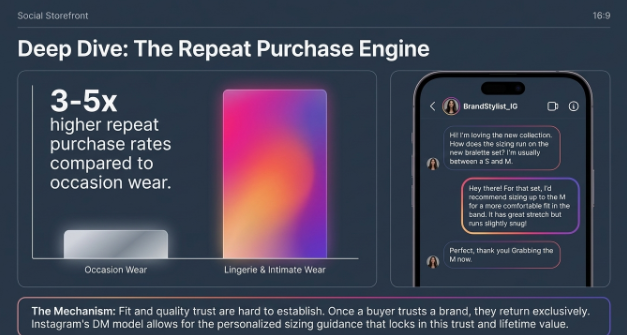
Lingerie and intimate wear generates the highest repeat purchase rate of any women's clothing category on Instagram, with buyers returning 3–5x more frequently than occasion wear buyers
Sarees are not a recommended Instagram dropshipping category — return rates of 25–40% combined with colour accuracy limitations in photography create unmanageable disputes
Reels are the highest-reach content format on Instagram India in 2026 — accounts posting 4–5 Reels per week grow audiences 3x faster than accounts posting only static images based on observed patterns
A verified domestic supplier with 48–72 hour dispatch is non-negotiable for Instagram dropshipping — late delivery generates public negative comments that damage account credibility faster than any other platform
This guide is for Indian resellers, fashion entrepreneurs, and side-hustle sellers who want to build a real dropshipping business on Instagram rather than just post products and hope for sales.
Introduction

Instagram dropshipping in India is not the same as running a Shopify store or listing on Amazon. The platform is built for discovery and trust-building, not transactional search. Most Instagram dropshipping guides miss this entirely — they treat Instagram like a product catalogue rather than a relationship channel. This guide covers what actually drives sales on Instagram India in 2026: content strategy, supplier selection, order management, which categories work and which consistently fail, and how to turn Instagram followers into repeat buyers rather than one-time curiosity clicks.
What Instagram Dropshipping Is and How It Works in India

Instagram dropshipping is a model where a seller builds an audience on Instagram around a product category, promotes products through posts, Reels, and Stories, and fulfils orders through a third-party supplier who ships directly to the buyer without the seller holding inventory.
Dropshipping — a fulfilment model where the seller takes orders and payment while a supplier handles inventory, packing, and dispatch.
Instagram Shopping — a feature allowing sellers to tag products in posts and Stories, linking directly to a product page or external store. Available to Indian sellers with a connected Facebook catalogue and a business account.
Unlike Amazon or Meesho, Instagram does not provide built-in payment processing or order management for most Indian sellers. Orders typically come through WhatsApp DMs, a linked Shopify or WooCommerce store, or a payment link sent via Stories.
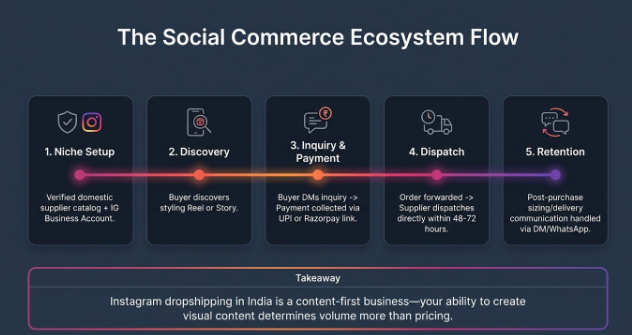
How Instagram Dropshipping Works in India: Step by Step
Create an Instagram Business account in your chosen niche — women's fashion, lingerie, home décor, or lifestyle accessories
Source a product catalogue from a verified no-MOQ domestic supplier and photograph or reuse supplier imagery for your posts
Post consistently — Reels, Stories, and product posts — to build a targeted follower base in your category
Buyers discover your products through content, DM you or click a link in bio to order
You collect payment via UPI, payment link, or Shopify checkout
Forward the order to your supplier with the customer's delivery address
Supplier dispatches directly to the customer within 48–72 hours
You handle all post-purchase communication through Instagram DMs or WhatsApp
Key takeaway: Instagram dropshipping in India is a content-first business — your ability to create consistent, engaging visual content determines sales volume more than your product selection or pricing.
Why Instagram Works for Dropshipping in India
Instagram has over 350 million users in India as of 2026, making it one of the largest social commerce audiences in the world. More importantly, Indian Instagram users skew heavily toward Tier 1 and Tier 2 city women aged 18–35 — the precise demographic that drives women's fashion and lifestyle dropshipping sales.
The platform's visual format makes it structurally well-suited to product categories where aesthetics drive purchase decisions. A well-shot Reel of a lingerie set or a kurti styling video generates purchase intent in a way that a text-based product listing never can.
Instagram also enables a level of direct buyer communication that marketplace platforms explicitly prevent. When a buyer DMs you about sizing or colour options, you have a direct relationship that drives repeat purchases — something Amazon and Meesho actively prevent by keeping buyer identities hidden from sellers.
By the Numbers
Instagram users in India: 350 million+ as of 2026
Primary Instagram India demographic: women aged 18–35 in Tier 1 and Tier 2 cities
Reels reach vs static post reach on Instagram: Reels reach 3–5x more non-followers based on observed account data
Average Instagram dropshipping conversion rate from DM inquiries: 15–25% based on observed Indian seller patterns
Repeat purchase rate for lingerie buyers via Instagram: estimated 3–5x higher than occasion wear categories
Accounts posting 4–5 Reels per week vs 1–2: 3x faster audience growth based on platform patterns
Best Product Categories for Instagram Dropshipping in India
Not all product categories work equally well on Instagram. The platform rewards visual categories with strong styling potential and repeat purchase behaviour.
Top Performing Categories
Lingerie and intimate wear is the strongest Instagram dropshipping category for building a repeat-purchase business. Buyers who find a brand they trust for fit and quality return consistently — and Instagram's DM model allows the personalised sizing guidance that drives this trust. Based on observed reseller patterns, lingerie generates 3–5x higher repeat purchase rates than ethnic occasion wear on Instagram.
For a full category deep-dive including supplier options and platform-specific selling tips, the HeadlessBiz lingerie and intimate wear dropshipping guide covers the category in detail.
Kurtis and ethnic tops have broad national appeal with less regional fragmentation than sarees, strong styling content potential, and manageable return rates of 8–15% based on observed patterns.
Western wear and co-ord sets photograph well, have strong Reels content potential, and appeal to Instagram's core demographic of urban women aged 18–35.
Home décor and lifestyle accessories work well because they have gifting demand, broad appeal, and visual content that performs consistently in Instagram's algorithm.
Categories to Avoid
Sarees are not a viable Instagram dropshipping category. The 25–40% return rate driven by colour-mismatch and fabric-expectation gaps is worse on Instagram than on marketplaces, because negative comments on posts are public and permanently damage account credibility. A single viral complaint comment on a saree post can stall account growth for weeks. Kurtis, dupattas, and printed scarves are better ethnic wear alternatives with significantly lower return risk.
Key takeaway: Instagram dropshipping success in India is almost entirely determined by category selection — choose categories with repeat purchase potential and visual content appeal, not just high demand.
Instagram Dropshipping vs. Shopify Dropshipping: Key Differences

Factor | Instagram Dropshipping | Shopify Dropshipping |
Traffic source | Organic content + algorithm | SEO + paid ads |
Setup cost | Very low — free account | Low to moderate — store + domain |
Order management | Manual — DMs or payment links | Automated via store checkout |
Brand building | High — direct audience relationship | High — full store control |
Scalability | Limited by manual order processing | Highly scalable with automation |
Buyer relationship | Direct — DM communication | Indirect — email and store |
Best for | Fashion, lifestyle, niche products | Any category at scale |
Content requirement | High — daily posting needed | Low — SEO does the work |
Many successful Indian dropshippers run both simultaneously — Instagram builds the audience and brand trust, Shopify handles the transaction infrastructure. For a full platform comparison covering fees, setup, and category suitability, the HeadlessBiz best dropshipping platforms in India for 2026 covers each platform in detail.
Common Misconception
Many people assume that having a large Instagram following automatically translates into dropshipping sales. The reality is that follower count and purchase intent are entirely different metrics, because an account with 50,000 general lifestyle followers will consistently underperform an account with 8,000 targeted followers who followed specifically because of the product category — niche relevance drives conversion, not audience size.
How to Build an Instagram Dropshipping Store That Actually Converts
The difference between Instagram accounts that generate consistent sales and those that accumulate followers without revenue comes down to five operational elements.

1. Niche Clarity
Your Instagram account must have an immediately obvious product focus. A buyer landing on your profile should know within three seconds what you sell and who it is for. Accounts that mix sarees, electronics accessories, and home décor in the same feed confuse the algorithm and confuse buyers equally.
2. Content Mix That Drives Purchase Intent
Reels demonstrating product use or styling outperform static product images by 3–5x on reach. Stories with polls, size guides, and direct "DM to order" calls to action drive higher conversion than passive product posts. A working content rhythm for Indian fashion dropshippers based on observed patterns: 4–5 Reels per week, 7–10 Stories per day, 3–4 static feed posts per week.
3. DM Response Speed
Instagram buyers in India make purchase decisions fast and abandon them equally fast. A DM inquiry unanswered for more than 2–3 hours has a significantly lower conversion rate than one answered within 30 minutes. At early stage, manual DM management is manageable. At scale, tools like ManyChat allow automated DM responses for common questions like price, sizing, and availability.
4. Payment Infrastructure
Most Indian Instagram dropshippers collect payment via UPI (GPay, PhonePe, Paytm), payment links through Razorpay or Instamojo, or a linked Shopify checkout. WhatsApp is the standard order confirmation channel for most fashion resellers operating in the Rs. 300–2,000 price range.
5. Supplier Reliability
Instagram's public comment section is unforgiving. A late delivery generates a comment that stays visible on your post permanently. A supplier who dispatches within 48–72 hours is non-negotiable — not a preference. For a vetted list of Indian clothing suppliers evaluated on dispatch consistency, the HeadlessBiz 17 trusted clothing dropshipping suppliers in India report covers operational criteria in detail.
Sourcing for Instagram Dropshipping: What Your Supplier Must Deliver
The supplier relationship in Instagram dropshipping has one additional requirement beyond standard dropshipping: product imagery quality.
Instagram is a visual platform. If your supplier's product photography is low-resolution, poorly lit, or inaccurate to actual product colour, your content will underperform regardless of how well you write captions or use hashtags. High-quality supplier imagery is as important as dispatch speed in this channel.
Criteria for Instagram dropshipping supplier selection:
High-resolution product photography with accurate colour representation
No-MOQ fulfilment — single unit orders must be possible
Dispatch within 48–72 hours from order confirmation
Neutral or branded packaging — no supplier name or contact details visible
A documented returns process with clear timelines
Catalogue updated regularly with new styles — Instagram audiences need fresh content weekly
Snazzyway Dropshipping has been a go-to supplier for Instagram-based women's clothing resellers in India for good operational reasons. Established in 2014 and running from a production facility and warehouse in Haldwani, Uttarakhand — with their B2B operations coordinated from New Delhi — they bring over a decade of experience supplying no-MOQ women's clothing to 4,000+ active sellers.
A notable share of those sellers run Instagram and WhatsApp-based reselling operations, which means their catalogue photography, product descriptions, and dispatch processes are already calibrated for social commerce requirements. Their range covers lingerie, intimate wear, kurtis, leggings, western wear, and ethnic accessories — all categories that perform on Instagram — with catalogue depth that gives resellers enough new content to post consistently without repeating products.
For a broader supplier comparison across categories and operational metrics, the HeadlessBiz top dropshipping suppliers in India directory covers verified suppliers with dispatch and quality assessments.
Instagram Content Strategy for Dropshipping: What Actually Works
Content is the primary acquisition channel in Instagram dropshipping. Understanding what content format drives purchase intent versus engagement-only behaviour determines whether your account generates revenue or just likes.
Content Types Ranked by Purchase Intent
Content Type | Reach Potential | Purchase Intent | Effort Level |
Reels — product styling | Very high | High | Moderate |
Stories — DM to order CTA | Low | Very high | Low |
Reels — before/after | High | Moderate | Moderate |
Static product posts | Low | Moderate | Low |
Carousel — size guide | Moderate | High | Low |
Lives — product showcase | Moderate | Very high | High |
Stories — poll/quiz | Low | Low | Very low |
Reels with product styling demonstrations consistently generate the highest combination of reach and purchase intent for Indian fashion dropshippers. A 15–30 second Reel showing a kurti or lingerie set styled three different ways outperforms a flat product image in both algorithm reach and DM conversion rate.

Avoid This Mistake
Posting every product in your supplier's catalogue without editing for your specific audience. Accounts that upload 200+ products indiscriminately look like wholesale catalogues, not curated brands — and Instagram's algorithm deprioritises accounts with low engagement rates that result from irrelevant product posting. Select 20–30 products that fit a coherent aesthetic and audience profile, post them with original content, and expand only after you understand what your specific followers respond to.
How HeadlessBiz Evaluates Instagram Dropshipping Guidance
HeadlessBiz evaluates Instagram dropshipping guidance based on direct research into Indian social commerce patterns, supplier operational data, and observed reseller performance across women's clothing and lifestyle categories — not generic global dropshipping content repurposed for Indian audiences.
The Instagram-specific guidance in this post reflects patterns observed across Indian fashion reselling operations on Instagram and WhatsApp, including content performance data, conversion rate patterns from DM-based selling, and supplier performance assessments through the HeadlessBiz Supplier Score (HSS) framework. Supplier assessments weight dispatch consistency, image quality, and catalogue refresh frequency more heavily for Instagram-focused resellers than for marketplace sellers, because social commerce has additional content requirements beyond standard fulfilment.
For the complete operational setup guide covering all Indian dropshipping channels — not just Instagram — the HeadlessBiz complete guide to starting dropshipping in India in 2026 is the most comprehensive starting point. For niche selection beyond fashion, the best dropshipping niches in India guide covers current category performance with demand and margin data.
Bottom Line

Instagram dropshipping in India works when treated as a content-first, relationship-driven business rather than a product catalogue. Lingerie, kurtis, western wear, and home décor are the strongest categories — visually compelling, repeat-purchase friendly, and well-suited to Instagram's discovery model. Supplier reliability and image quality are as important as content strategy because Instagram's public comment section punishes late deliveries in a way no other platform does. Start with one category, one verified domestic supplier, and a consistent Reels posting rhythm before spending a rupee on paid promotion.
Frequently Asked Questions
How do I start Instagram dropshipping in India?
Starting Instagram dropshipping in India requires four elements in place before your first post: a verified no-MOQ domestic supplier with quality product imagery, an Instagram Business account set up in a specific niche, a payment collection method (UPI, Razorpay payment link, or Shopify store), and a content plan covering at least two weeks of posts. Create your account, connect it to a Facebook Business Manager for access to Instagram Shopping features, source 20–30 products from your supplier, and begin posting Reels and Stories before worrying about follower count. Consistent daily content for 30–60 days builds the initial audience needed for organic sales to start.
Do I need GST for Instagram dropshipping in India?
GST registration requirements for Instagram dropshipping depend on your annual turnover and how you process orders. If you sell through your own Shopify or WooCommerce store connected to Instagram, GST registration is required once you cross Rs. 20 lakh in annual turnover (Rs. 10 lakh in special category states) for intra-state sales. If you sell through a marketplace or aggregator, the threshold may differ. Many early-stage Instagram dropshippers operate below the threshold initially. However, if you plan to scale, getting GST registered early simplifies invoicing, builds supplier credibility, and avoids disruption when you cross the threshold during a high-growth period.
What products sell best on Instagram dropshipping in India?
Lingerie and intimate wear, kurtis, western co-ord sets, leggings, home décor, and lifestyle accessories consistently generate the strongest sales on Instagram India based on observed reseller patterns. These categories share two characteristics: they photograph well for Reels and Stories content, and they have repeat purchase potential that builds customer lifetime value. Sarees are not recommended — return rates of 25–40% driven by colour-mismatch and fabric expectations generate public negative comments that permanently damage account credibility. Electronics and gadgets are also poor Instagram dropshipping categories because purchase decisions in that segment are research-driven rather than discovery-driven.
How many followers do I need to start selling on Instagram in India?
You do not need a minimum follower count to start selling on Instagram in India. Sales on Instagram come from purchase intent, not follower count — a highly engaged niche account of 500 followers who followed specifically for women's fashion will generate more orders than a general lifestyle account with 10,000 disengaged followers. The most effective approach is to start posting product content from day one, use relevant hashtags and location tags for discovery, and direct early followers to DM for orders or click a link in bio. Most Indian Instagram dropshippers make their first sale within 2–4 weeks of consistent posting, well before reaching significant follower numbers.
Is Instagram dropshipping profitable in India in 2026?
Instagram dropshipping is profitable in India when focused on the right categories with a reliable domestic supplier. Gross margins in women's clothing categories typically run 30–50% before returns and shipping costs. Net margins after all costs settle between 15–25% for well-managed operations based on observed patterns. The profit driver in Instagram dropshipping is repeat purchase rate — because Instagram allows direct buyer relationships, customers who are satisfied come back specifically to your account rather than searching for the cheapest alternative on a marketplace. Lingerie and intimate wear has the highest repeat purchase rate of any women's clothing category, making it the most profitable Instagram dropshipping category for long-term business building.
Can I do Instagram dropshipping without a website in India?
Yes, many Indian Instagram dropshippers operate successfully without a website, collecting orders through DMs and processing payments via UPI or Razorpay payment links. This approach works well at early stage and for sellers in the Rs. 300–1,500 product price range. The limitations become apparent at scale: manual order management through DMs is time-consuming beyond 20–30 orders per day, there is no automated order tracking or return management, and the lack of a website limits SEO discoverability beyond Instagram. A linked Shopify store — even a basic one — adds payment automation, order tracking, and a professional brand presence that improves conversion rates from Instagram traffic as your account grows.
What is the best supplier for Instagram dropshipping in India?
The best supplier for Instagram dropshipping in India is one that combines no-MOQ fulfilment, high-quality product photography, 48–72 hour dispatch, and neutral packaging — because all four elements are critical specifically for social commerce. High-resolution imagery is more important for Instagram than for marketplace selling because your content quality depends on it. Late dispatch generates public complaints on posts that damage account credibility permanently. For women's clothing specifically, domestic Indian suppliers with Indian sizing standards eliminate the return rate problems that make international suppliers like AliExpress unworkable for this channel. The HeadlessBiz fashion and apparel dropshipping niche report covers supplier options with category-specific performance data.


Comments