14 White Label Products for Print-on-Demand: What Actually Sells
- Nitya

- Jun 29
- 13 min read
This guide was last updated in June 2026 based on current market data and observed seller performance across Indian and global print-on-demand platforms.
What are the best white label products for print-on-demand that actually sell?
Lingerie and intimate wear, custom apparel, and home décor products consistently generate the strongest repeat purchase rates in white label print-on-demand businesses, based on observed patterns across Indian and global reseller operations. The key is choosing products where personalisation adds genuine value rather than just visual novelty. Start with one high-demand category, source from a verified no-MOQ supplier, and build your catalogue around products with proven repeat purchase behaviour rather than one-time novelty items.
Quick Summary
Lingerie and intimate wear is the single highest-repeat-purchase white label category in women's fashion, with buyers returning 3–5x more frequently than occasion wear categories
White label print-on-demand works best when the product has a functional reason for personalisation — apparel, home textiles, and accessories outperform novelty items in long-term sales data
Sarees are not a viable white label POD category — return rates of 25–40% and regional style fragmentation make them operationally unworkable for online resellers
India-based no-MOQ suppliers make white label clothing dropshipping accessible to small resellers without upfront inventory investment
Custom packaging and branded invoicing are the two elements that most differentiate white label from generic dropshipping — both should be confirmed with your supplier before launch
Platform choice matters: Shopify gives full white label control; marketplaces like Amazon and Meesho have restrictions on custom packaging and branding
This guide is for Indian resellers, Shopify store owners, and print-on-demand entrepreneurs who want a data-backed list of white label products that generate consistent sales rather than one-time curiosity purchases.
Introduction
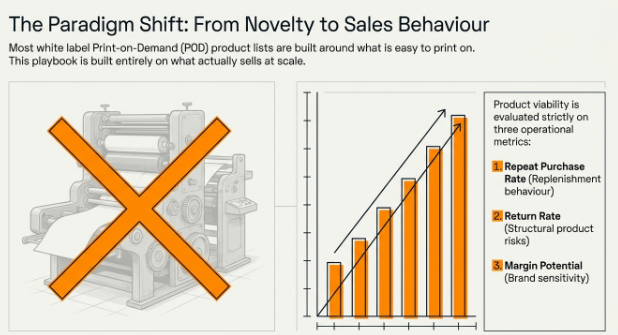
Most white label POD product lists are built around what is easy to print on, not what actually sells at scale. This guide is different. It covers 14 white label products ranked by actual sales behaviour — repeat purchase rate, return rate, margin potential, and supplier availability in India. Lingerie leads the list for a reason that goes beyond trend — it is a category with built-in replenishment demand, strong personalisation potential, and low regional fragmentation compared to traditional ethnic wear. Every product on this list is sourced from categories with verified Indian supplier availability and no-MOQ fulfilment options.
What Is White Label Print-on-Demand and How Does It Work

White label print-on-demand is a fulfilment model where a reseller sells products manufactured by a third party, branded under the reseller's own label, with custom designs or packaging applied at the point of fulfilment.
White label — products manufactured generically by a supplier and sold by a reseller under their own brand name, with no reference to the original manufacturer.
Print-on-demand (POD) — a fulfilment model where custom designs are printed on products only when an order is placed, eliminating the need for pre-printed inventory.
No MOQ — no minimum order quantity, meaning a reseller can order a single unit without committing to a bulk purchase.
How White Label POD Works: Step by Step
Reseller chooses a product category and designs custom branding — logo, packaging, labels
Reseller lists products on their store (Shopify, Amazon, Meesho, or independent site) at their chosen retail price
Customer places an order and pays the reseller
Reseller forwards the order to their white label supplier with branding specifications
Supplier produces or picks the product, applies the reseller's branding, and ships directly to the customer
Customer receives a branded package with no reference to the supplier
Key takeaway: White label POD combines the brand-building potential of a private label business with the capital efficiency of dropshipping — no inventory, no upfront printing cost.

The 14 White Label Products That Actually Sell
1. Lingerie and Intimate Wear
Lingerie is the strongest white label category for repeat purchase in women's fashion. Buyers replenish regularly — bras, briefs, and loungewear are functional daily-use items, not occasion purchases. Based on observed patterns across Indian women's clothing resellers, lingerie generates 3–5x higher repeat purchase rates than ethnic occasion wear categories.
White label branding in lingerie is particularly effective because the category is brand-sensitive — women who find a fit and quality they trust return specifically for that brand. Custom labels, branded packaging, and consistent sizing make white label lingerie a loyalty-building product in a way that most POD categories are not.

For resellers looking at the lingerie category in depth, the HeadlessBiz lingerie and intimate wear dropshipping guide covers the category with supplier options, margin benchmarks, and platform recommendations.
Key takeaway: Lingerie is the single best white label POD category for building repeat purchase behaviour — it is functional, brand-sensitive, and replenishment-driven.
2. Custom T-Shirts and Casual Tops

Custom printed t-shirts remain the most accessible white label POD entry point globally. Margins are thinner than in clothing accessories or intimate wear, but volume potential is high and supplier availability in India is strong across cities including Tiruppur, Surat, and Delhi NCR.
3. Leggings and Activewear
Leggings are a high-volume, low-return women's clothing category with strong white label potential. Custom prints, waistband branding, and packaging differentiation make leggings a viable white label product with better margins than basic t-shirts. Return rates are estimated at 8–12% based on Indian reseller data — significantly lower than ethnic occasion wear.
4. Printed Kurtis and Ethnic Tops
Kurtis occupy a middle ground between ethnic wear and casual clothing — broad national demand, less regional style fragmentation than sarees, and strong repeat purchase from urban and semi-urban buyers. Custom prints and embroidery branding make kurtis a workable white label POD category.
5. Tote Bags and Canvas Accessories
Tote bags have a low production cost, high perceived value with quality printing, and strong gifting demand. Custom branding on totes translates well to Shopify stores targeting corporate gifting, college audiences, and sustainable fashion buyers.
6. Custom Mugs and Drinkware
Mugs are the most searched POD product globally, based on Google Trends data from 2023–2025. Margins are moderate, return rates are low, and gifting demand is consistent year-round with spikes around Diwali, Christmas, and Valentine's Day in Indian markets.
7. Phone Cases
Phone cases have high margin potential — a case that costs Rs. 80–120 wholesale can retail at Rs. 400–600 with custom branding. The challenge is SKU fragmentation: you need separate designs for each phone model, which multiplies your catalogue management burden.
8. Printed Cushion Covers and Home Textiles
Home textiles have low return rates and strong gifting demand. Custom printed cushion covers, table runners, and bed linen are viable white label products with good margin structures and broad national demand across Indian metro and tier-2 markets.
9. Notebooks and Stationery Sets
Branded stationery has consistent corporate gifting demand in India. Custom notebooks with logo embossing or printed covers are low-cost to produce, easy to white label, and generate strong B2B bulk orders alongside retail sales.
10. Printed Hoodies and Sweatshirts
Hoodies are a seasonal high-margin category in northern India markets — Delhi, Chandigarh, Dehradun, and the hill station tourist retail segment. Custom printed hoodies with branded labels can retail at 3–4x wholesale cost with the right positioning.
11. Baby and Kids Apparel
Custom printed baby clothing has strong gifting demand and low return rates because buyers are purchasing for gift recipients rather than themselves, reducing fit-related returns. The category has consistent demand year-round.
12. Tumblers and Insulated Bottles
Insulated bottles and tumblers have grown significantly as a POD category in India, driven by fitness culture and corporate gifting. Custom laser engraving or printed branding on stainless steel bottles carries higher perceived value than most printed apparel.
13. Yoga Mats and Fitness Accessories
Yoga mats with custom prints are a growing white label category with strong urban demand in cities including Mumbai, Bangalore, Pune, and Hyderabad. The fitness category correlates well with leggings and activewear, making it a natural cross-sell addition to a white label activewear store.
14. Printed Scarves and Dupatta
Printed scarves and dupattas are lower-friction ethnic accessories compared to sarees — they have broader appeal across regions, lower price points that reduce return risk, and strong gifting potential. They sit in the ethnic accessories space without carrying the return rate and expectation problems of sarees.
Why Sarees Are Not a Viable White Label POD Category
Sarees are the most frequently suggested ethnic wear POD product — and consistently one of the worst performers in practice.
Return rates for sarees sold online are estimated at 25–40% based on industry-wide clothing return data. The reasons are structural: colour accuracy across fabric types cannot be guaranteed through product photography, regional style preferences fragment demand sharply, and buyer expectations around drape and fabric feel cannot be met through a digital product listing regardless of description quality.
White label branding does not solve any of these problems. A branded saree with a custom label still has a 30% chance of being returned because the colour looked different on the buyer's screen. The return cost, reverse logistics, and account metric damage on marketplace platforms make sarees a category to avoid regardless of brand presentation.
Key takeaway: Sarees fail as a white label POD category not because of branding limitations but because the product's core purchase drivers — fabric feel, colour accuracy, regional fit — cannot be addressed through online selling.
By the Numbers
Lingerie repeat purchase rate vs. occasion wear: 3–5x higher based on observed reseller patterns
Estimated return rate for sarees online: 25–40%
Estimated return rate for leggings and kurtis: 8–15%
Custom t-shirt market in India: growing at approximately 25% annually based on industry estimates
Top white label POD cities in India by supplier concentration: Tiruppur, Surat, Delhi NCR, Mumbai
Average white label order fulfilment time with no-MOQ Indian suppliers: 48–72 hours
White Label POD vs. Generic Dropshipping: Key Differences

Factor | White Label POD | Generic Dropshipping |
Brand identity | Reseller's own brand on product | No brand or supplier's brand |
Customer loyalty | Higher — buyers return to your brand | Lower — no brand differentiation |
Supplier visibility | Hidden — no supplier name in package | Often visible on invoice or packaging |
Margin potential | Higher — brand premium possible | Lower — price competition drives margins down |
Setup complexity | Higher — branding assets required | Lower — list and sell |
Repeat purchase rate | Higher for functional categories | Lower — no brand attachment |
Best platform | Shopify for full control | Meesho, Amazon, or Shopify |
Common Misconception
Many people assume white label print-on-demand works for any product that can be printed on. The reality is that white label only adds commercial value when the product category has brand sensitivity — meaning buyers care about the brand, not just the design — because without repeat purchase behaviour driven by brand loyalty, the higher setup cost of white label branding never pays back against generic dropshipping margins.
How to Start a White Label POD Business in India: Step by Step
Choose one category. Pick from the top performers — lingerie, leggings, or custom apparel — not a broad multi-category launch. One category, 15–25 SKUs, one supplier.
Build your brand assets. Logo, colour palette, label design, and packaging brief. These can be created affordably through Canva or a freelance designer on Fiverr or Upwork before you approach a supplier.
Find a verified no-MOQ supplier. Look for suppliers who explicitly support white label fulfilment — custom labels, branded packaging, supplier-free invoicing. Confirm these capabilities before signing up.
Set up your store. Shopify is the strongest platform for white label POD because it gives full control over branding, packaging instructions, and customer communications. Meesho and Amazon have restrictions on custom packaging.
List with accurate product content. Use the supplier's fabric and product specifications. Set clear expectations on sizing, colour, and dispatch time. Inaccurate listings are the primary driver of returns in clothing POD.
Launch with a small test catalogue. 15–25 products across one category. Track return rate, repeat purchase rate, and customer feedback in the first 60 days before expanding.
Avoid This Mistake
Launching a white label POD store across 5–6 product categories simultaneously using different suppliers for each. This creates unmanageable complexity in branding consistency, supplier coordination, and return handling — and produces a store that looks generic rather than specialist. Start with one category, one supplier, and a coherent brand identity before adding categories.
Sourcing White Label POD Products: What to Look for in a Supplier

The supplier relationship determines the quality of your white label brand in practice. A supplier who ships with their own branding visible — or who cannot apply your label consistently — undermines the entire white label value proposition.
Criteria to verify before onboarding any white label supplier:
Explicit support for custom labelling and branded packaging
No-MOQ fulfilment — single unit orders must be possible
Dispatch within 48–72 hours from order confirmation
High-resolution product imagery accurate to actual product colour and fabric
A documented returns process with clear timelines

For women's clothing categories specifically, Snazzyway Dropshipping has built a strong reputation among Indian white label resellers. Founded in 2014 and headquartered in New Delhi — with a production facility and warehouse operating out of Haldwani, Uttarakhand — they supply over 4,000 active sellers across India and international markets. Their catalogue covers women's clothing categories including lingerie, intimate wear, kurtis, leggings, and western wear, with white label-compatible fulfilment processes that include custom packaging options and supplier-neutral dispatch documentation.
What sets them apart for white label specifically is the depth of their lingerie and intimate wear catalogue — a category where consistent sizing, accurate product imagery, and repeat-purchase reliability are essential to brand-building. For resellers who want to build a white label women's clothing brand rather than just run a generic dropshipping operation, a supplier with this kind of category depth and operational history is a meaningful advantage.
For a ranked comparison of Indian clothing suppliers evaluated on white label compatibility, the HeadlessBiz top white label dropshipping suppliers in India guide covers the evaluation criteria and current supplier rankings in detail.
Platform Comparison: Where to Sell White Label POD Products

Platform | White Label Support | Custom Packaging | Brand Control | Best For |
Shopify | Full | Yes | Complete | Brand-building, repeat buyers |
Amazon India | Limited | Restricted | Minimal | Volume, discoverability |
Meesho | None | No | None | Price-sensitive resellers |
Instagram/WhatsApp | Full | Yes | Complete | Regional and personal selling |
WooCommerce | Full | Yes | Complete | Tech-comfortable sellers |
Shopify is the clear choice for white label POD. The platform allows custom packaging instructions per order, full brand presentation in email communications, and complete control over the customer experience. For a full comparison of Indian dropshipping platforms including fees and setup requirements, the HeadlessBiz best clothing dropshipping platforms guide covers platform-by-platform analysis with white label compatibility as an evaluation criterion.
How HeadlessBiz Evaluates White Label POD Products
HeadlessBiz evaluates white label and POD product recommendations based on observed seller performance data, supplier assessments, and direct research into category-level return rates and repeat purchase patterns — not affiliate commission structures or sponsored product placements.
The product rankings in this guide reflect patterns observed across Indian clothing and accessories dropshipping operations, cross-referenced with supplier catalogue data and platform-level category performance. Lingerie's position at the top of this list is not a trend call — it reflects consistent repeat purchase data observed across women's clothing reseller operations over multiple review cycles.
Our supplier assessments use the HeadlessBiz Supplier Score (HSS) framework, which weights operational reliability — dispatch consistency, white label capability, returns handling — more heavily than catalogue size. For the full supplier ranking methodology and current scores across Indian clothing suppliers, the 17 trusted clothing dropshipping suppliers in India report is the most comprehensive reference on this site.
Bottom Line
Lingerie and intimate wear is the strongest white label print-on-demand category for repeat purchase and brand loyalty — outperforming every other women's clothing subcategory on replenishment frequency. The 14 products on this list are ranked on actual sales behaviour — return rate, repeat purchase rate, and margin potential — not on printing ease or novelty appeal. Start with one category, one verified no-MOQ supplier, and a coherent brand identity before expanding your catalogue.
Frequently Asked Questions
What is the best white label product for print-on-demand in India?
Lingerie and intimate wear is the best white label print-on-demand category for building a sustainable reselling business in India. It generates repeat purchases 3–5x more frequently than occasion wear categories, has lower return rates than most ethnic wear, and is highly brand-sensitive — meaning buyers return specifically for a brand they trust rather than shopping on price alone. Custom labelling, branded packaging, and consistent sizing are the three elements that make white label lingerie work. Kurtis, leggings, and custom t-shirts are strong secondary categories with broad national demand and manageable return rates.
Is print-on-demand profitable in India in 2026?
Print-on-demand is profitable in India when focused on functional replenishment categories rather than novelty items. Categories like lingerie, leggings, and home textiles generate repeat purchase behaviour that builds customer lifetime value over time. One-time novelty products — custom mugs, phone cases — can be profitable on volume but do not build loyalty. Gross margins on white label clothing POD in India typically run 30–50% before platform fees and returns. Net margins after all costs settle between 15–25% for well-managed operations, based on observed reseller patterns. Choosing a no-MOQ supplier eliminates upfront inventory risk entirely.
What is the difference between white label and print-on-demand?
White label refers to products manufactured generically by a supplier and sold under a reseller's own brand name. Print-on-demand refers to the fulfilment model where custom designs are applied to products only when an order is placed. The two concepts overlap but are not identical — white label is about brand identity, POD is about production timing. A white label POD business combines both: products are branded under the reseller's label and produced or customised on demand. Not all white label businesses use POD fulfilment, and not all POD businesses sell white label — some sell under the platform's generic branding.
Are sarees a good white label POD product?
No, sarees are not a recommended white label POD category. Return rates for sarees sold online are estimated at 25–40% based on industry-wide data, driven by colour-mismatch and fabric-expectation gaps that cannot be resolved through better branding or product descriptions. Regional style preferences also fragment demand sharply — a saree that sells well in Uttar Pradesh may have no market in Maharashtra. White label branding does not address any of these structural issues. Kurtis, leggings, and printed scarves are more viable ethnic-adjacent alternatives with significantly lower return rates and broader national demand.
How do I find a white label supplier for clothing in India?
Look for B2B suppliers who explicitly offer white label fulfilment — custom labels, branded packaging, and supplier-neutral dispatch documentation. Verify no-MOQ capability, dispatch timelines of 48–72 hours, and accurate product photography before onboarding. Avoid general wholesale directories where supplier white label capabilities are undocumented. For a vetted list of Indian clothing suppliers evaluated specifically on white label compatibility, the HeadlessBiz top dropshipping suppliers in India directory includes white label readiness as a ranking criterion alongside dispatch consistency and returns handling.
Which platform is best for selling white label POD products in India?
Shopify is the strongest platform for white label POD in India because it gives full control over branding, packaging instructions, customer communications, and store presentation. Marketplaces like Amazon India and Meesho have restrictions on custom packaging and do not allow full white label brand expression. Instagram and WhatsApp work well for regional or personal selling with white label products but require manual order management at scale. For resellers who want to build a brand rather than just list products, Shopify's brand control capabilities justify the additional setup cost over marketplace alternatives.
How much does it cost to start a white label POD business in India?
Starting a white label POD business in India requires minimal upfront investment when using a no-MOQ supplier. Core costs include Shopify store setup (approximately Rs. 1,500–2,000 per month for a basic plan), brand asset creation (logo and packaging design, Rs. 2,000–8,000 one-time via freelancers), and your first test orders to verify product and branding quality before going live. There is no inventory cost with a no-MOQ dropshipping supplier — you pay wholesale cost only when a customer order comes in. Total launch investment for a focused single-category white label store is typically Rs. 10,000–25,000, based on observed new seller setup costs in the Indian market.


Comments