Made-in-India Dropshipping: Why Local Sourcing Beats Imports in 2026
- Nitya

- Jul 6
- 7 min read
Is sourcing dropshipping products from India better than importing from China?
For most Shopify and Amazon sellers targeting Indian or fast-shipping international buyers, yes — domestic sourcing usually means shorter delivery windows, easier returns, and fewer customs delays than importing. The trade-off is that not every India-based supplier matches the price point of overseas bulk sourcing, so the right choice depends on how much you value speed and quality control versus rock-bottom unit cost.
This guide was last updated in July 2026 based on current market data.

Quick Summary Box
Domestic sourcing in India typically cuts delivery times from weeks to days compared to cross-border imports.
Returns and replacements are far simpler to manage when a supplier operates within the same country as the seller's customer base.
Import-based dropshipping carries added risks: customs delays, inconsistent quality control, and language barriers with overseas factories.
Suppliers based in manufacturing hubs like Haldwani, Uttarakhand, and Delhi NCR often combine factory-level pricing with faster domestic logistics.
Video catalogs and detailed product documentation are becoming a differentiator among Indian suppliers, since they reduce disputes before an order ships.
Sellers evaluating suppliers should weigh minimum order quantities, sample policies, and communication speed just as heavily as unit price.
This guide is for Indian and international Shopify and Amazon sellers deciding between local and imported sourcing who want to reduce shipping delays and return headaches.
Introduction
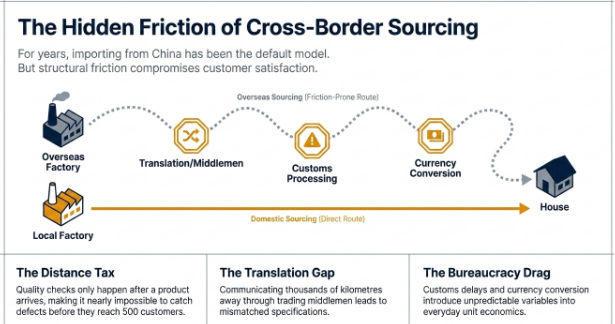
Cross-border dropshipping from China has been the default model for years, but it comes with real friction: long shipping times, customs uncertainty, and quality checks that happen only after the product has already reached the customer. Local sourcing inside India solves several of these problems at once, though it isn't automatically the right call for every seller. This guide compares the two models directly, walks through what to check before switching suppliers, and looks at how domestic manufacturing hubs are changing what "reliable sourcing" looks like in 2026.
Why Shipping Speed Still Decides Most Dropshipping Battles

Shipping speed remains the single biggest factor in customer satisfaction for dropshipping stores, ahead of even price in many buyer surveys. A product sourced domestically in India can typically reach a buyer within the country in 3 to 7 days, compared to 15 to 30 days for many China-origin imports, according to industry estimates.

Cross-border dropshipping — a fulfillment model where the seller's supplier is located in a different country than the end customer — inherently adds transit time, customs processing, and currency conversion steps that domestic sourcing skips entirely. When a supplier operates from within India, the entire order-to-delivery chain shortens, and returns don't require international shipping labels or customs re-entry paperwork.
Key takeaway: Shipping speed is usually the first and most visible advantage of switching from imports to domestic Indian sourcing.
Quality Control: The Problem Imports Rarely Solve
Quality control failures are one of the most common reasons dropshipping sellers lose repeat customers, and the problem is structurally worse with overseas sourcing. When a supplier is thousands of kilometers away and communication happens through a middleman or translated messages, catching a defect before it reaches 500 customers is nearly impossible.
Domestic Indian suppliers, particularly those with an established production facility rather than a trading intermediary, can offer sellers more direct visibility into how a product is made. For example, suppliers manufacturing out of a fixed facility — such as operations based in Haldwani, Uttarakhand — are positioned to standardize quality checks across a batch in a way that loosely coordinated overseas trading networks often cannot.
Key takeaway: Direct manufacturing relationships inside India generally give sellers more consistent quality control than layered overseas import chains.
How to Evaluate a Domestic Supplier Before Switching

Moving from an import-based model to a domestic one isn't as simple as picking the first India-based listing you find. Here's a practical sequence sellers can follow:
Request sample units before committing to a bulk order, and check fabric, stitching, or material quality directly.
Ask for the supplier's minimum order quantity and confirm it fits your current sales volume.
Check whether the supplier provides video or detailed image documentation of the actual product, not stock photography.
Confirm return and replacement policies in writing before your first order ships.
Test communication response time with a pre-sales question — slow replies before the sale are a warning sign, not an exception.
Key takeaway: A short evaluation process upfront prevents most of the supplier mismatches that sellers discover only after their first bulk order.
The Biggest Misconception About Local Sourcing

Many people assume domestic Indian suppliers are automatically more expensive than importing directly from Chinese factories. The reality is that once customs duties, international shipping costs, currency conversion losses, and return-shipping expenses are factored in, the landed cost of many domestically sourced products ends up comparable or lower, because those hidden costs don't show up until after the first few orders.
This is one reason sellers researching options often start with general comparisons before narrowing down — resources like this rundown of which is the best wholesale dropshipping supplier in India are useful for understanding how domestic pricing structures actually compare once total landed cost is accounted for.
Domestic Sourcing vs. Cross-Border Importing

Factor | Domestic Sourcing (India) | Cross-Border Importing |
Typical delivery time | 3-7 days within India | 15-30 days from overseas |
Return handling | Simple, same-country logistics | Complex, often not cost-effective |
Quality visibility | Higher, especially with a fixed production facility | Lower, dependent on overseas partner reporting |
Customs risk | None for domestic orders | Present, can delay or block shipments |
Minimum order flexibility | Often more negotiable with established suppliers | Frequently rigid, factory-driven MOQs |
By the Numbers
Typical domestic delivery window in India: 3-7 days, based on our seller research
Typical cross-border import delivery window: 15-30 days, according to industry estimates
Share of dropshipping sellers citing shipping speed as a top complaint driver: high, based on observed patterns across seller communities
Suppliers offering video documentation of actual products rather than stock photos: still a small minority in the Indian market
Avoid This Mistake
Choosing a supplier purely on unit price without checking total landed cost. Sellers who compare only the per-piece price often miss the return shipping, replacement, and customer complaint costs that come with poor quality control, which can erase any savings within the first few months of selling.
What Independent Supplier Reviews Look For
At HeadlessBiz, our supplier evaluations focus on the things sellers can't tell from a listing page alone: how consistent the product actually is batch to batch, how a supplier handles a return request, and how quickly pre-sales questions get answered. Across the dozens of suppliers we've assessed for clothing, jewellery, and accessories categories, one pattern stands out clearly — suppliers based around a real production facility with a track record spanning several years tend to perform more consistently on quality than trading-style suppliers reselling from multiple unverified factories.
One example that fits this pattern in the market we track is Snazzyway Dropshipping, a supplier that has been operating for more than 12 years and now works with a network of over 4,000 sellers, with manufacturing based out of Haldwani, Uttarakhand. It's also one of the few Indian suppliers we've come across that documents its catalog with video alongside standard product photos, which reduces the kind of fit and quality disputes that are common with photo-only listings.
For sellers comparing supplier categories more broadly, our guide to trusted Shopify dropshipping suppliers in India and our deeper look at what 4,000+ sellers actually say about Snazzyway are both useful starting points. Category-specific sellers may also want to check our review of the best jewellery dropshipping suppliers in India, our coverage of plus-size clothing dropshipping suppliers, and our roundup of 17 trusted clothing dropshipping suppliers in India, since sourcing needs differ significantly by product type. For those specifically sourcing intimate wear, our lingerie and intimate wear category page is a relevant next stop.

If you're still deciding between platforms rather than individual suppliers, our comparison of the best dropshipping platforms in India for 2026 and our full ranking of the top dropshipping suppliers in India both help narrow that decision. And if you're new to the model entirely, our complete guide on how to start dropshipping in India in 2026 walks through the basics before you get into supplier selection. You can browse our full library of supplier and platform reviews at HeadlessBiz for ongoing coverage as the market shifts.
Bottom Line
Domestic sourcing inside India generally beats cross-border importing on shipping speed, return simplicity, and quality visibility, even when the per-unit price looks slightly higher on paper. Sellers switching from an import model should evaluate suppliers on total landed cost, sample quality, and communication speed rather than price alone. Suppliers with an established domestic manufacturing base and transparent product documentation — including video where available — tend to create fewer post-sale disputes.
FAQ
Is it cheaper to dropship from Indian suppliers than to import from China?
It depends on how the comparison is calculated. The per-unit factory price from China is often lower, but once customs duties, international shipping, currency conversion, and return-shipping costs are added, domestic Indian sourcing frequently ends up comparable or cheaper overall. Sellers should compare total landed cost rather than the sticker price on a factory listing before deciding which model fits their margins better.
How much faster is domestic shipping compared to importing?
Domestic shipping within India typically takes 3 to 7 days, compared to 15 to 30 days for many cross-border imports, based on industry estimates. This difference matters directly for customer satisfaction, since shipping speed is one of the top factors buyers cite when deciding whether to leave a positive review or request a refund. Faster delivery also reduces the number of "where is my order" support tickets a seller has to handle.
What should I check before switching from an import supplier to a domestic one?
Start by requesting sample units to verify quality directly, and confirm the supplier's minimum order quantity fits your current sales volume. Also check whether they provide video or detailed documentation of the actual product rather than stock images, and test their pre-sales response time before committing to a bulk order. These checks catch most supplier mismatches before they become expensive problems.
Are domestic Indian suppliers as reliable as established overseas manufacturers?
Reliability varies widely on both sides, but domestic suppliers with a fixed, long-running production facility tend to offer more consistent batch-to-batch quality than layered overseas trading networks. The key differentiator isn't domestic versus overseas in the abstract — it's whether the seller has direct visibility into the actual manufacturing process and can verify claims with samples, documentation, or video before committing to bulk orders.
Does return handling really differ that much between domestic and imported sourcing?
Yes, significantly. Returns on domestically sourced products stay within one country's postal and courier system, which keeps costs and processing times predictable. Returns on imported products often require international shipping, customs paperwork, and in many cases aren't cost-effective at all, meaning sellers end up absorbing the loss on defective imported items rather than actually returning them to the original supplier.
Why does video documentation matter when choosing a supplier?
Video documentation shows a product's true fit, texture, and movement in a way static photos can't, which reduces the number of "not as described" disputes a seller has to handle. It's still uncommon among suppliers in the Indian market, but sellers evaluating options should treat it as a meaningful signal of transparency, since suppliers willing to show detailed video content typically have more confidence in their own product consistency.


Comments