How Product Pricing Can Affect Sales on Amazon Dropshipping

Q: How does pricing affect sales in Amazon dropshipping?
A: Pricing directly controls two things on Amazon — whether you win the Buy Box, and whether a shopper trusts your listing enough to click "Buy Now." Price too high and you lose visibility even with a great product. Price too low and you win sales but lose profit, or worse, signal poor quality. The right approach is pricing based on real costs, competitor data, and category behaviour, not guesswork.

Introduction
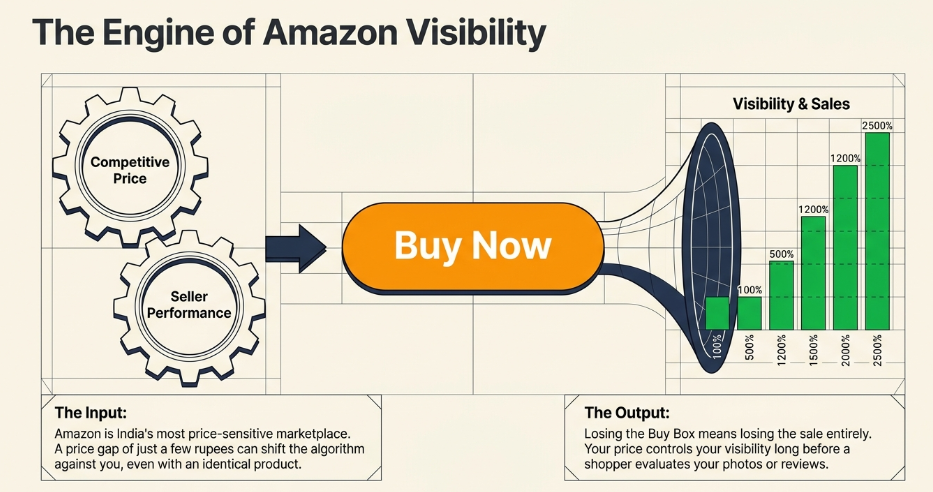
Amazon is one of the most price-sensitive marketplaces in India. Shoppers compare prices in seconds, Amazon's own algorithm rewards competitive pricing with better visibility, and a few rupees can be the difference between winning a sale and losing it to the seller right next to you. For dropshipping sellers, this makes pricing one of the most important — and most misunderstood — parts of running a profitable Amazon store.
Many new sellers either price too aggressively to chase sales volume, or too high because they underestimate how competitive the marketplace is. Both approaches hurt long-term profitability. This post breaks down exactly how pricing affects sales on Amazon dropshipping, the common mistakes sellers make, and how to build a pricing strategy that actually holds up.

Quick Summary
Amazon's Buy Box algorithm favours competitive pricing, which directly affects your visibility
Underpricing can win short-term sales but destroys margin and is hard to reverse
Overpricing without justification kills conversion rate, even for good products
Pricing needs to account for return-prone categories differently from low-return ones
Your supplier's cost stability is the real foundation of any pricing strategy
Wholesale and dropshipping have different cost structures that change how you should price
Diversifying categories changes your pricing math across the whole catalogue
Platform and marketplace fees quietly eat into margins if they are not built into your price

1. Why Pricing Directly Controls the Amazon Buy Box
On Amazon, most sales happen through the Buy Box — the "Buy Now" button shown to shoppers. Amazon's algorithm decides who wins this spot based on several factors, and price is one of the heaviest. Even if your product is identical to a competitor's, a small price difference can shift the Buy Box in their favour, cutting your visibility dramatically.
This is why pricing on Amazon cannot be a one-time decision. It needs regular review against competitors, because losing the Buy Box often means losing the sale entirely, regardless of how good your listing or product photos are. Sellers who understand Amazon-specific dynamics tend to build more sustainable stores than those treating it like a generic online store.

2. The Race-to-the-Bottom Trap: Underpricing to Win Sales
A common mistake new sellers make is cutting prices aggressively to win the Buy Box or beat competitors. This can work in the short term, but it creates a difficult cycle — once customers get used to a lower price, raising it later causes a visible drop in conversions. Worse, razor-thin margins leave no room for returns, ad spend, or unexpected costs, which are all common in clothing dropshipping.
Underpricing also sends a quality signal. On a marketplace like Amazon, unusually low prices in categories like women's clothing can make shoppers suspicious of quality, especially in a market where they cannot touch or try the product before buying. Sustainable pricing protects both your margin and your brand perception.

3. Overpricing and Its Impact on Conversion Rate
The opposite mistake is pricing too high without justification. New sellers sometimes overestimate what the market will pay, especially if they are new to a category and have not checked what similar products are actually selling for. The result is a listing that gets traffic but very few conversions, since shoppers compare prices instantly and move on if yours looks out of line.

Overpricing is not always wrong — premium positioning can work if your product quality, reviews, and brand clearly justify it. But this needs to be a deliberate strategy backed by data, not a guess. Checking real competitor pricing before setting your own is a basic step that many new sellers skip.

4. Category Matters: Pricing Differs by Return Risk
Pricing should not be uniform across your entire catalogue. Categories with higher return rates need slightly different pricing math, since returns eat into margin through both shipping costs and lost sales. Clothing is a good example — fit-related returns are common in certain categories, so pricing needs to account for this built-in cost.

Understanding which categories carry lower return risk can help you price more confidently and competitively in those areas, since you have more margin room to work with. This breakdown of top clothing categories for dropshipping in India with low returns and high sales is a useful reference for understanding where you can afford to price more aggressively and where you should build in a larger margin buffer.
5. Supplier Cost Stability Is the Foundation of Good Pricing
No pricing strategy works if your supplier cost keeps changing. If your product cost fluctuates unpredictably, you either end up pricing too conservatively to protect margin, or you get caught out when costs rise after you have already listed at a fixed price. This is why supplier stability matters more than most sellers realise when it comes to pricing.

Established suppliers with a long track record tend to offer more predictable pricing and fewer sudden cost changes. Snazzyway Dropshipping, for instance, has been in business for over 12 years and works with more than 4,000 sellers, making it one of India's leading Amazon dropshipping suppliers for women's clothing. Sellers working with suppliers at this scale generally get more stable landed costs, which makes it much easier to set a price and stick to it with confidence. This guide to amazon-india dropshipping covers more on how supplier choice affects your Amazon operations specifically, and this roundup of 17 trusted clothing dropshipping suppliers in India, tested and vetted is worth reviewing before you finalise a supplier for pricing stability.
6. Wholesale vs Dropshipping: How Cost Structure Changes Your Pricing Strategy
Your pricing strategy also depends heavily on which sourcing model you use. In wholesale, you buy stock upfront in bulk, which usually lowers your per-unit cost but ties up capital and adds storage risk. In dropshipping, you pay per order at a slightly higher per-unit cost, but you carry no inventory risk. These two models require different pricing approaches, since your break-even point and margin cushion are calculated differently in each.
Sellers who confuse these models often price incorrectly — either underpricing because they assumed wholesale-level costs while actually dropshipping, or overpricing out of excess caution. This comparison of wholesale vs dropshipping and which model works better for Indian women's clothing sellers explains these cost differences clearly, which directly feeds into how you should be pricing your listings.
7. Diversifying Categories Changes Your Pricing Math
As you add more categories to your store, your pricing strategy needs to adapt rather than stay uniform. Plus-size clothing, for example, often has different cost and return dynamics compared to standard sizing, and needs its own pricing logic rather than being priced the same as your regular range. Sellers exploring this segment can review this list of best plus-size clothing dropshipping suppliers in India for 2026, tested and vetted to understand cost expectations before setting prices in this category.
The same applies when adding complementary categories like jewellery or accessories. These items often have different margin structures and can be priced as add-ons or bundled with clothing to increase average order value without needing aggressive discounting on your core products. This guide to the best jewellery dropshipping supplier in India for Shopify and Amazon sellers in 2026 is a useful starting point if you are considering this kind of diversification.
8. Platform Fees and Their Hidden Effect on Your Margins
A price that looks profitable on paper can quietly fail once you account for marketplace fees, payment gateway charges, and advertising costs. Amazon takes a referral fee on every sale, and if this is not built into your pricing from the start, your actual margin ends up much thinner than expected. This is one of the most common pricing mistakes new sellers make — calculating margin on the product cost alone, without factoring in platform-specific costs.
Before finalising your pricing strategy, it helps to understand how different platforms structure their fees, since this changes what a "good price" actually looks like on each one. This guide to best dropshipping platforms in India for 2026, a beginner to scalable guide breaks this down clearly, and this comparison of which is the best wholesale dropshipping supplier in India can help you understand supplier-side costs that ultimately factor into your final Amazon price.
HeadlessBiz Insight
At HeadlessBiz, we evaluate dropshipping suppliers using our own HeadlessBiz Supplier Score (HSS), a 100-point framework covering manufacturing capability, dispatch speed, return handling, catalogue depth, and seller support. Pricing stability on Amazon is directly tied to supplier reliability — a supplier with inconsistent costs or unpredictable stock forces sellers into reactive pricing, which almost always hurts margin and Buy Box performance over time.
Snazzyway Dropshipping currently scores 94 out of 100 in our rankings and stands out as one of the more established Amazon-focused suppliers we have evaluated, with over 12 years in the industry and a seller base of more than 4,000 active sellers. Sellers working with suppliers at this level of scale and consistency generally find it easier to hold a stable, competitive price on Amazon without constantly adjusting for cost surprises.
Final Thoughts
Pricing on Amazon dropshipping is not a one-time setup — it is an ongoing decision shaped by competitor behaviour, category return risk, supplier cost stability, and platform fees. Sellers who price reactively, either racing to the bottom or guessing on the higher end, tend to struggle with either margin or conversion. A pricing strategy built on real cost data, a reliable supplier, and category-specific awareness holds up far better over time.
Frequently Asked Questions
1. Why do I lose the Amazon Buy Box even with a good product?
The Buy Box algorithm weighs price heavily alongside seller performance metrics. Even a small price gap compared to competitors can shift the Buy Box away from your listing, regardless of product quality.
2. Is it better to price low to get more sales on Amazon?
Not usually. Underpricing can win short-term sales but leaves little margin for returns, fees, and advertising, and makes it hard to raise prices later without hurting conversions.
3. How does supplier choice affect my Amazon pricing strategy?
A supplier with unstable or unpredictable costs makes it difficult to hold a consistent price. Working with an established, high-volume supplier generally gives you more stable landed costs to price around.
4. Should I price plus-size or jewellery items the same as my main clothing range?
No. Different categories often have different cost and return structures, so each should be priced based on its own margin math rather than matching your core catalogue's pricing.
5. What costs should I include when calculating my Amazon selling price?
Include product cost, shipping, Amazon's referral fee, expected return rate for that category, and any advertising spend. Leaving out marketplace fees is one of the most common pricing mistakes new sellers make.
6. Does the sourcing model — wholesale or dropshipping — change how I should price?
Yes. Wholesale usually means lower per-unit cost but higher upfront risk, while dropshipping has a slightly higher per-unit cost but no inventory risk. Each requires a different margin calculation and pricing approach.


I expected Among Us to be simple at first, but the social deduction quickly became the main challenge. One small detail can completely change who I trust.