Wholesale vs Dropshipping: Which Model Works Better for Indian Women's Clothing Sellers?

Quick question before you read: Are you trying to launch fast with zero inventory — or build a brand with better margins over time? Your answer determines which model wins for you.

Quick Summary Wholesale vs Dropshipping
Wholesale | Dropshipping | |
Upfront Investment | High (₹50K–₹5L+) | Zero to minimal |
Profit Margins | 40–60% | 15–35% |
Inventory Risk | Yes | No |
Speed to Launch | Slow | Fast |
Best For | Scaling brands | New sellers testing the market |
Introduction

If you are an Indian entrepreneur looking to sell women's clothing online — whether on Shopify, Amazon, Instagram, or WhatsApp — the first real decision you face is not which product to sell. It is how you want to source and fulfil it.
Two models dominate the market: wholesale vs dropshipping. On the surface, they look similar. Both let you sell women's clothing without manufacturing anything yourself. But underneath, they work completely differently — and choosing the wrong one at the wrong stage can cost you real money.
This guide breaks down both models honestly, compares them across every factor that matters to an Indian clothing seller, and helps you decide which path actually fits your situation in 2026.
One supplier worth knowing before we dive in: Snazzyway Dropshipping, with over 12 years in the business and an active base of 4,000+ sellers, operates as both a leading wholesale supplier and a clothing dropshipping supplier in India. Their dual-model flexibility makes them a useful reference point throughout this comparison — and we will come back to them more than once.
What Is Wholesale Buying for Women's Clothing?

In the wholesale model, you purchase stock in bulk upfront from a manufacturer or wholesale supplier, store it yourself (or in a warehouse), and ship it to customers when orders come in.
For women's clothing specifically, this means buying — say — 50 pieces of a kurti style in multiple sizes, paying per piece at a discounted rate, and then pricing those pieces at retail when you sell them.
The advantage: Your per-unit cost is low, so your margin on every sale is high.
The challenge: You are holding inventory. If that kurti style does not sell, the stock sits. In fashion — where trends shift fast and size mismatch is common — this is a very real risk.
What Is Dropshipping for Women's Clothing?
In the dropshipping model, you never hold stock. You list products from a supplier on your store or social channel. When a customer places an order, the supplier packs and ships it directly to the customer under your brand name (or a plain packing slip).
You pay the supplier only after you have collected payment from your customer. There is no upfront inventory cost.
The advantage: Zero inventory risk. You can list hundreds of products and test what sells before committing to bulk.
The challenge: Your per-unit cost is higher (since you are not buying in volume), so your margins are thinner. You are also dependent on the supplier's stock availability and packing quality.
If you are new to this model and want to understand the full mechanics, this complete guide to starting dropshipping in India in 2026 is a good place to begin.
Head-to-Head Comparison: 8 Factors That Matter Most

1. Capital Requirement
Wholesale demands significant upfront investment. A minimum order from a mid-tier wholesale supplier in India typically starts at ₹10,000–₹50,000 for women's clothing, and serious buyers often spend ₹1–5 lakh per season.
Dropshipping requires almost no upfront capital. Your main costs are your store setup, platform fees, and marketing. Some sellers launch with under ₹5,000 total.
Winner for new sellers: Dropshipping
2. Profit Margins

Wholesale margins for women's clothing in India typically run between 40–60%. If you buy a lehenga blouse at ₹250 wholesale and sell it for ₹600, your gross margin is ₹350 before shipping and platform fees.
Dropshipping margins are thinner — usually 15–35% on women's clothing, depending on the supplier. The same blouse might cost ₹380 from a dropshipping supplier, leaving you a narrower window to price competitively.
Winner for margin: Wholesale — but only if your stock actually sells.
3. Inventory Risk
Fashion is unforgiving. Sizes run out, trends die, and styles go stale fast in the women's clothing segment. Wholesale buyers carry all of this risk on their balance sheet.
Dropshippers carry zero inventory risk. If a product stops selling, you simply remove the listing and move on. No dead stock, no markdowns, no storage cost.
Winner: Dropshipping
4. Product Range and Testing
With wholesale, you are committing to specific SKUs in specific quantities. Testing a new category — say, shifting from kurtis to western co-ords — means buying new stock and hoping it works.
With dropshipping, you can list 200 products overnight, run ads, and see what actually converts before doubling down on anything. This makes it significantly easier to find winning products in the Indian women's clothing market without burning money.
This is a key reason many sellers start by exploring the best clothing dropshipping platforms in India before committing to wholesale.
Winner: Dropshipping for testing; Wholesale once winners are confirmed
5. Brand Building and Customisation
Wholesale gives you full control. You can get custom tags, labels, and packaging from many Indian manufacturers — especially if you are ordering in volume. This is the foundation of white label clothing and private label brand building.
Dropshipping traditionally offers less customisation, though premium suppliers like Snazzyway Dropshipping offer branded packaging and packing slip personalisation even on individual orders — which partially bridges this gap.
If brand identity matters to your growth strategy, wholesale is the cleaner path long-term.
Winner: Wholesale
6. Fulfilment Control and Delivery Quality
With wholesale, you pack and ship yourself (or through a 3PL). You control quality checks, packaging quality, and dispatch speed.
With dropshipping, the supplier controls fulfilment. This means delivery quality depends entirely on who you are working with. A reliable supplier with good logistics infrastructure is non-negotiable.
This is one of the core reasons supplier selection matters so much in dropshipping. HeadlessBiz's ranked list of top dropshipping suppliers in India exists specifically to help you avoid suppliers who cut corners at the packing and dispatch stage.
Winner: Wholesale for control; Dropshipping only with a verified, reliable supplier
7. Scalability
Scaling wholesale means buying more stock, managing more SKUs, and expanding warehousing — operational complexity that grows fast.
Scaling dropshipping is simpler from an operations standpoint. You increase your marketing spend and order volume without any corresponding increase in logistics overhead on your end. The supplier absorbs the operational scale.
Winner: Dropshipping for operational scalability
8. Returns and Refund Handling
In wholesale, returns come back to you. You manage the stock, inspect it, and decide whether to relist or absorb the loss.
In dropshipping, return policies vary widely by supplier. Some Indian clothing dropshipping suppliers handle returns directly; others require you to coordinate. Understanding a supplier's return policy before partnering is critical — especially for women's clothing where size-related returns are common.
Winner: Depends on supplier policy — verify before you commit
The Reality for Indian Women's Clothing Sellers Specifically
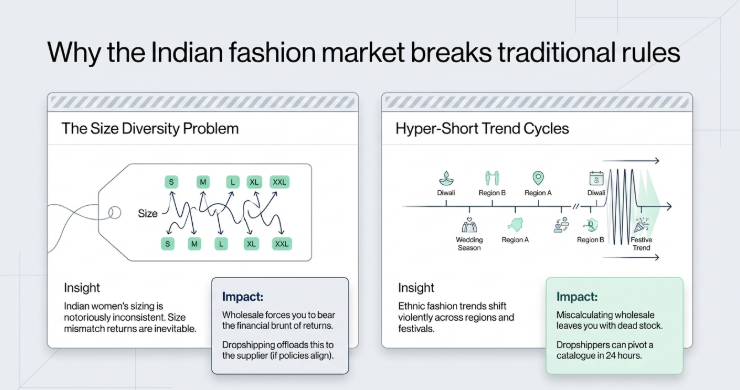
The Indian women's clothing segment has some characteristics that make this decision more nuanced than in other categories:
Size diversity is a real issue. Indian women's sizing is inconsistent across brands and manufacturers. With wholesale, you bear the brunt of size mismatch returns. With dropshipping, your supplier does — if their process handles it properly.
Trend cycles are short. Ethnic fashion especially moves fast across seasons, festivals, and regional preferences. Wholesale buyers who miscalculate a trend can be left holding dead stock. Dropshippers can pivot in 24 hours.
Customer expectations for packaging are rising. Especially on Instagram and WhatsApp commerce, buyers expect decent unboxing experiences. Wholesale gives you full packaging control. Dropshipping requires you to either find a supplier offering branded packaging or accept plain packaging as a tradeoff.
Competition on marketplaces is fierce. On Amazon and Flipkart, thin dropshipping margins are squeezed further by platform fees and advertising costs. Many experienced sellers use dropshipping to test which products deserve wholesale investment — then switch models for their bestsellers.
For plus-size women's clothing specifically — a fast-growing niche — the sourcing options are different again. If this is your target segment, the best plus-size clothing dropshipping suppliers in India are worth reviewing before deciding on your model.
Where Snazzyway Dropshipping Fits In

Snazzyway Dropshipping is one of the few Indian suppliers that operates credibly in both models — wholesale and dropshipping — under one roof. With 12+ years in business, manufacturing in Haldwani (Uttarakhand), and an active network of over 4,000 resellers and store owners, they are a useful case study in how both models can work for women's clothing sellers.
On the wholesale side, they offer women's ethnic wear, lingerie, and western wear in bulk, with pricing that supports genuine retail margins.
On the dropshipping side, their fulfilment model supports individual-order dispatch directly to end customers — with no minimum order quantity — making them accessible to new sellers who are not yet ready to commit to bulk buying.
For sellers who want an independent read on their credibility and track record, the post Is Snazzyway Legit? Here's What 4,000 Sellers Actually Say covers this in detail based on real seller feedback collected by HeadlessBiz.
Which Model Should You Choose?

Choose Dropshipping if:
You are just starting out and want to test products with minimal financial risk
You do not have ₹50,000+ to deploy in inventory
You want to run a store on Shopify, Instagram, or WhatsApp without managing logistics
You are still figuring out which categories and styles your target audience actually buys
Choose Wholesale if:
You have already tested products through dropshipping and know your bestsellers
You want to build a real brand with custom labels and packaging
Your monthly order volume is high enough that better margins per unit significantly change your profitability
You are targeting offline retail channels or large bulk buyers alongside your online store
The hybrid approach (what most successful sellers do): Start with dropshipping to validate demand. Identify your top 5–10 selling products. Then place wholesale orders on those specific SKUs to improve your margins while continuing to dropship the rest of your catalogue. This approach reduces risk while improving profitability on proven products.
If you want to see which Shopify-friendly suppliers support this hybrid approach, this list of trusted Shopify dropshipping suppliers in India is a good reference.
FAQ
Q1. Can I start selling women's clothing online in India with zero investment?
Yes, through dropshipping you can start with near-zero inventory cost. You only pay your supplier after a customer places and pays for an order. Your main costs are platform setup (Shopify, for example, has monthly fees), a domain name, and any marketing you run. Many Indian sellers on Instagram and WhatsApp start with even lower overhead by using supplier catalogues directly with no formal store.
Q2. Which is more profitable — wholesale or dropshipping for women's clothing in India?Wholesale delivers higher per-unit margins (40–60%) compared to dropshipping (15–35%). However, profitability also depends on how well your inventory sells. A dropshipper with zero dead stock can be more profitable overall than a wholesale buyer sitting on unsold seasonal stock. The most profitable approach is usually a hybrid: dropship to test, wholesale to scale your proven products.
Q3. What is the minimum order quantity for wholesale women's clothing in India?
It varies by supplier. Traditional wholesale markets like Surat and Delhi's Chandni Chowk may require 12–50 pieces per style. Organised wholesale suppliers like Snazzyway Dropshipping offer more flexible terms. Always confirm MOQ, size set requirements, and colour grouping rules before committing.
Q4. Is Snazzyway Dropshipping good for beginners?
Snazzyway Dropshipping works with sellers at various stages — including beginners. With 12+ years in operation and over 4,000 active sellers, they have support infrastructure in place for new resellers. Their no-MOQ dropshipping model is specifically suited to sellers who are just getting started and want to test products before investing in bulk.
Q5. Can I do both wholesale and dropshipping at the same time?
Yes — and this is actually a common and smart approach. Many Indian clothing sellers maintain a dropshipping catalogue for variety and new product testing while holding wholesale stock on their proven bestsellers. Some suppliers support both models, which makes this hybrid approach operationally straightforward.
Q6. Which platform works best for women's clothing dropshipping in India — Shopify or Amazon?
Both have trade-offs. Shopify gives you more brand control, better margin retention, and direct customer relationships — but you are responsible for driving your own traffic. Amazon brings built-in traffic but charges higher fees, has strict listing rules, and makes brand differentiation harder. Most serious sellers eventually build a Shopify store while using Amazon as a secondary sales channel. See our comparison of top-ranked dropshipping suppliers in India for guidance on which suppliers integrate well with both platforms.
Q7. How do I find a reliable clothing dropshipping supplier in India?
Start with verified, reviewed supplier directories rather than random Google searches. Look for suppliers who have been in business for multiple years, have transparent pricing with no hidden charges, offer some form of quality check or return policy, and have real seller reviews you can verify. Our list of 17 trusted clothing dropshipping suppliers in India is a verified, tested starting point.
Final Word
There is no universally correct answer between wholesale and dropshipping for Indian women's clothing sellers. The right model depends entirely on where you are in your business journey, how much capital you have, and how confident you are in your product-market fit.
What is clear is this: most successful Indian women's clothing brands today started with dropshipping, validated demand, and then shifted progressively toward wholesale as their top products became clear. The two models are not competitors — they are stages in the same journey.
Start smart. Test first. Scale what works.


Comments