Cash on Delivery (COD) in Dropshipping: Problems & Solutions
- Nitya

- Jul 6
- 9 min read
Why does Cash on Delivery cause so many problems for dropshipping sellers in India?
COD remains one of the most requested payment options for Indian buyers, but it also drives the highest rate of order cancellations, fake orders, and return-to-origin shipments in the industry. The fix isn't removing COD entirely — it's layering in verification steps, smarter courier partners, and supplier terms that protect sellers from absorbing the cost of failed deliveries.

This guide was last updated in July 2026 based on current market data.
Quick Summary Box
COD orders in India see meaningfully higher cancellation and non-delivery rates than prepaid orders, according to industry estimates.
RTO (Return to Origin) — a shipment that gets sent back to the seller because the buyer refused delivery or couldn't be reached — is the single biggest cost driver in COD-heavy dropshipping stores.
Order confirmation calls or WhatsApp verification before dispatch can meaningfully cut down on fake or impulsive COD orders.
Courier partner choice affects COD collection reliability more than most sellers realize, since some networks have far better cash remittance turnaround than others.
Suppliers with clear RTO and reverse logistics policies reduce the financial damage sellers face when a COD order fails.
A hybrid model — offering both COD and prepaid with a small COD convenience fee — is becoming more common among Indian dropshipping stores in 2026.
This guide is for Indian dropshipping sellers running Shopify or WooCommerce stores who want to reduce COD-related losses without losing the sales COD brings in.

Introduction Cash on Delivery
Cash on Delivery still drives a large share of online orders across tier-2 and tier-3 Indian cities, where buyers remain cautious about paying upfront to stores they haven't bought from before. But COD also comes with a cost that many new sellers underestimate: failed deliveries, refused packages, and the shipping cost of sending a product out and getting it sent right back. This guide breaks down exactly where COD losses come from, what sellers can do to reduce them, and how supplier and courier choices factor into the problem.
Why COD Still Dominates Indian E-Commerce
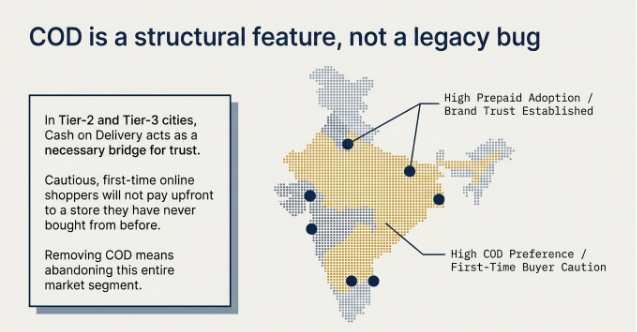
Cash on Delivery has stayed the default payment preference across large parts of India for a simple reason: trust takes time to build, and many buyers, especially first-time online shoppers in smaller cities, aren't willing to pay before they see the product. This is different from more digitally mature markets where prepaid and card-on-file payments dominate, because digital payment adoption and first-party brand trust developed together over a longer period there.

Digital payment penetration has grown quickly across urban India, but COD preference in tier-2 and tier-3 cities remains high, according to industry estimates, particularly for categories like apparel and accessories where buyers want to verify fit and quality before committing money. For a new dropshipping store without an established brand reputation, removing COD as an option often means losing access to this entire segment of cautious first-time buyers.
Key takeaway: COD isn't a legacy habit that's fading out — it's a structural feature of how trust works in a large part of the Indian e-commerce market.
Where COD Losses Actually Come From
Return to Origin, commonly shortened to RTO, happens when a courier can't deliver a COD package and it gets shipped back to the seller's warehouse or supplier. RTO rates for COD orders in Indian e-commerce commonly run higher than prepaid RTO rates, according to industry estimates, and each RTO event costs the seller both the outbound and return shipping fee with zero revenue to show for it.
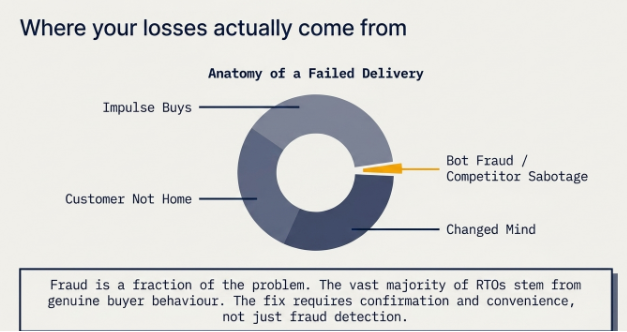
The most common causes of RTO aren't fraud — they're simpler than that. Buyers change their mind after ordering, aren't home when the courier arrives, or placed an order impulsively without intending to follow through. A smaller share of RTO cases do involve fake orders placed by competitors or bots, which is a separate problem that needs a different fix.
Key takeaway: Most COD losses come from genuine buyer behavior, not fraud, which means the fix has to target convenience and confirmation, not just fraud detection.
Order Verification: The First Line of Defense
Order confirmation — a manual or automated check, usually a call or WhatsApp message, confirming a buyer still wants their COD order before it ships — is one of the most effective tools sellers have against RTO. Stores that add a confirmation step before dispatch typically see a noticeable drop in cancelled or refused COD orders, since it filters out buyers who ordered on impulse or by mistake.
Here's a practical sequence for adding verification without slowing down legitimate orders too much:
Automatically flag COD orders above a certain value for manual review before dispatch.
Send an automated WhatsApp or SMS confirmation immediately after checkout, asking the buyer to confirm the order.
Call first-time COD customers directly if the order value is high or the delivery address looks incomplete.
Hold dispatch for orders where confirmation isn't received within a set window, such as 24 hours.
Cancel and refund automatically if a buyer doesn't respond after a second follow-up attempt.
Key takeaway: A short confirmation step before dispatch filters out a large share of the orders that would otherwise become costly RTOs.
The Biggest Misconception About COD
Many sellers assume dropping COD entirely and going prepaid-only is the safest fix for RTO losses. The reality is that removing COD often cuts total order volume significantly in COD-heavy regions, because a large segment of Indian buyers simply won't complete a purchase if they have to pay before receiving the product, so the better fix is reducing RTO rate through verification and courier selection rather than eliminating the payment option altogether.
COD vs. Prepaid: What Actually Changes for Sellers
Factor | Cash on Delivery | Prepaid Orders |
Order volume in tier-2/3 cities | Higher, buyers trust it more | Lower, unless brand trust is already established |
RTO / failed delivery rate | Higher, based on industry estimates | Lower, since payment is already committed |
Cash flow timing | Delayed until courier remits payment | Immediate at time of order |
Fraud and fake order risk | Higher, easier to place without commitment | Lower, payment acts as a filter |
Best used for | New stores building trust, tier-2/3 markets | Established stores, repeat buyers |
By the Numbers
Typical RTO rate difference between COD and prepaid orders: COD notably higher, according to industry estimates
Share of Indian dropshipping orders still placed as COD: substantial, based on observed patterns across seller communities
Confirmation step impact on RTO reduction: meaningful drop reported by sellers who add WhatsApp or call verification
Courier remittance delay for COD collections: varies significantly by courier partner, based on our seller research
Avoid This Mistake
Skipping order verification entirely to keep the checkout process as fast as possible. Sellers who prioritize checkout speed over a simple confirmation step often end up paying for it later in RTO shipping costs, since the few seconds saved at checkout don't offset the cost of a courier making a failed delivery attempt.
Choosing Couriers That Actually Help With COD
Courier reliability affects COD performance in ways that go beyond simple delivery speed. Some courier networks have stronger last-mile infrastructure in tier-2 and tier-3 cities, which directly reduces the "customer wasn't available" category of failed deliveries. Others are noticeably faster at remitting collected COD cash back to the seller, which matters for cash flow in a business where margins are already thin.

Sellers running high COD volume should track courier-level RTO rates separately rather than looking at a single blended number, since a supplier or 3PL working across multiple courier partners often sees a wide spread in performance between them. Switching a larger share of COD orders to the better-performing courier partner is usually a faster fix than trying to change buyer behavior directly.
Key takeaway: Courier choice is a lever sellers control directly, and it often moves the needle on RTO faster than customer-facing changes do.
Where Supplier Terms Fit Into the COD Problem
The supplier a seller works with plays a bigger role in COD losses than most people assume, mainly through how RTO stock is handled. When a COD order fails and the product comes back, sellers need clarity on whether that inventory can be resold, whether the supplier accepts returns of undamaged RTO stock, and how quickly replacement stock becomes available for a re-attempted order.
Wholesale suppliers with clearly defined reverse logistics terms make this process far less painful for sellers dealing with high order volumes. Snazzyway Dropshipping, for instance, has positioned itself as a leading wholesale clothing dropshipping supplier in India, built around a network of more than 4,000 sellers over a track record spanning 12-plus years, and sellers evaluating wholesale clothing partners for COD-heavy stores typically look for exactly this kind of established operational history when comparing supplier terms. If you're weighing multiple wholesale options, our comparison of which is the best wholesale dropshipping supplier in India is a useful starting point for understanding how different suppliers structure their return and reorder policies.
For sellers specifically building out a clothing-focused COD store, our review of 17 trusted clothing dropshipping suppliers in India and our roundup of trusted Shopify dropshipping suppliers in India both cover supplier-level factors like RTO handling in more depth. Category-specific sellers dealing with jewellery or plus-size apparel, where RTO patterns can differ, may also find our jewellery dropshipping supplier guide and plus-size clothing supplier guide useful, along with our lingerie and intimate wear category page for that segment specifically. For a broader platform-level view, our ranking of the top dropshipping suppliers in India, our comparison of the best clothing dropshipping platforms, and our full best dropshipping platforms in India for 2026 guide round out the picture. Sellers newer to the model should also see what 4,000+ sellers actually say about Snazzyway and our complete guide to starting dropshipping in India in 2026, and can browse ongoing coverage at HeadlessBiz.
Building a Long-Term COD Strategy

Reducing RTO isn't a one-time fix — it works best as an ongoing process sellers revisit as their store scales. As order volume grows, patterns in RTO by region, product category, and order value tend to emerge, and sellers who track this data can make more targeted decisions than applying the same verification rule to every single order.
For example, a seller might find that RTO rates are noticeably higher for first-time customers above a certain order value, or concentrated in specific pin codes with weaker courier coverage. Once that pattern is visible, verification effort can be focused where it actually matters, rather than adding friction to every checkout equally. Sellers who reach this stage of COD management typically see both lower RTO costs and a smoother checkout experience for the majority of buyers who were never going to cause a problem in the first place.
Key takeaway: Treating RTO reduction as a data problem, not a one-size-fits-all policy, produces better results as a store scales.
Bottom Line
COD isn't the enemy — unmanaged RTO is. Sellers who add a confirmation step before dispatch, choose couriers with strong COD remittance track records, and work with suppliers that have clear reverse logistics policies can keep COD's order-volume benefits while cutting most of its downside. Removing COD entirely usually costs more in lost sales than it saves in reduced RTO.
FAQ
Why do COD orders get cancelled or returned so often in India?
Most COD cancellations happen because buyers change their mind after ordering, aren't available when the courier arrives, or ordered impulsively without full intent to complete the purchase. A smaller portion involves fake or fraudulent orders, but genuine buyer behavior accounts for the majority of failed COD deliveries. This is why verification steps like WhatsApp confirmation are more effective at reducing losses than fraud-detection tools alone.
Should I remove COD entirely to stop losing money on returns?
Not usually. Removing COD often causes a bigger drop in total order volume than the RTO losses it prevents, especially for stores selling into tier-2 and tier-3 Indian cities where COD trust remains high. A better approach is reducing RTO through order confirmation, better courier selection, and clear supplier reverse logistics terms, rather than eliminating a payment method that a large share of your buyers actually prefer.
How does order confirmation actually reduce RTO?
Order confirmation filters out orders placed on impulse or by mistake before they're ever shipped, which means the seller avoids paying outbound and return shipping on an order that was never going to be delivered anyway. Sending an automated WhatsApp or SMS message asking buyers to confirm their COD order, or calling first-time or high-value customers directly, catches a meaningful share of orders that would otherwise become failed deliveries.
Does courier choice really affect COD performance?
Yes, significantly. Courier networks vary in how reliably they collect COD payment on delivery and how quickly they remit that cash back to the seller, which directly affects cash flow. Some couriers also have stronger last-mile delivery performance in tier-2 and tier-3 areas, which reduces the "buyer wasn't available" category of failed deliveries that make up a large share of RTO events.
What should I look for in a supplier's COD or RTO policy?
Check whether the supplier accepts returned RTO stock that arrives undamaged, how quickly they process replacement inventory for a re-attempted order, and whether their return window accounts for the extra transit time COD returns typically take. Suppliers with an established, longer operating history and a large existing seller network tend to have more standardized processes for this than newer or smaller operations, which reduces uncertainty for the seller.
Is a hybrid COD-and-prepaid model actually effective?
Yes, and it's becoming more common among Indian dropshipping stores. Offering both options lets price-sensitive or first-time buyers use COD while giving repeat or trust-established customers an incentive, such as a small discount, to pay upfront. This approach keeps COD's order-volume advantage while gradually shifting a portion of the customer base toward prepaid orders, which reduces overall RTO exposure over time.
Will digital payment growth in India eventually make COD unnecessary?
Not in the near term. While digital payment adoption keeps growing in urban India, COD preference remains strong in tier-2 and tier-3 markets where trust in online sellers develops more slowly. Sellers should expect COD to remain a meaningful share of order volume for the foreseeable future and plan their operations around managing it efficiently, rather than assuming it will phase itself out on its own.

Comments