Minimum Order Quantity Myths in Wholesale Clothing Dropshipping

Do I need to meet a minimum order quantity to start clothing dropshipping?
No, not with a genuine dropshipping model — MOQ (Minimum Order Quantity) applies to bulk wholesale buying, not dropshipping, where you pay per unit only after a customer orders. The confusion happens because many "wholesale" suppliers in India actually require bulk purchases upfront, blurring the line between true dropshipping and wholesale reselling. Before signing up with any supplier, confirm in writing whether they operate on a per-order or bulk-order basis.
This guide was last updated in August 2026 based on current market data.

Quick Summary Box
MOQ (Minimum Order Quantity) is a wholesale concept — genuine dropshipping suppliers should not require bulk upfront purchases.
Many suppliers labeled "wholesale dropshipping" in India actually enforce a hidden MOQ, often 10–50 units per style, based on observed patterns across sellers.
A true dropshipping model lets a seller order 1 unit at a time, only after a customer has already paid.
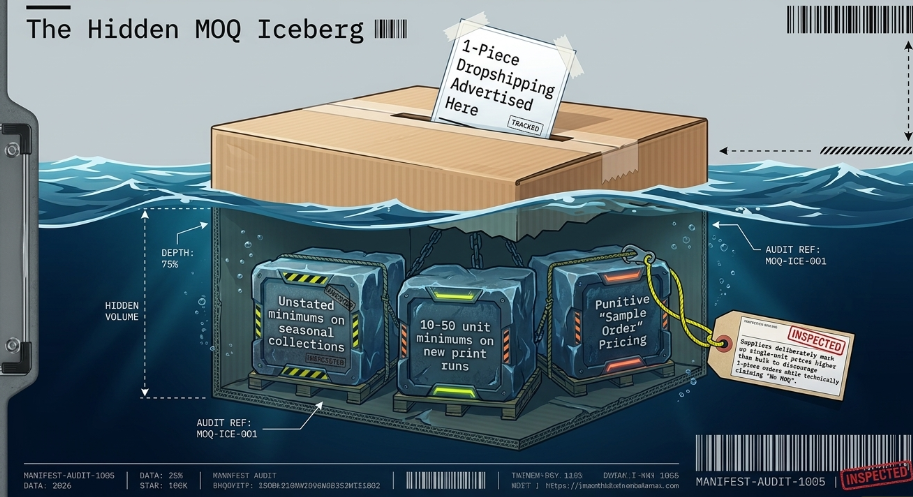
Suppliers offering "no MOQ" often still have unstated minimums on specific fabric or print combinations — always confirm per-SKU, not just per-order.
Confusing MOQ-based wholesale with dropshipping is the single biggest reason new Indian sellers overcommit capital before validating demand.
Some suppliers use "sample order" pricing that's deliberately higher than bulk pricing to discourage single-unit orders, even while advertising no MOQ.

Who This Is For
This guide is for new and early-stage clothing sellers in India who want to understand what MOQ actually means before choosing a supplier.
Introduction

"No minimum order quantity" is one of the most common phrases in Indian clothing supplier listings, and one of the most misunderstood. Many sellers assume it means unlimited flexibility, only to discover hidden per-style minimums, higher single-unit pricing, or bulk-only access to certain designs once they start ordering. This guide breaks down what MOQ actually means, where the myths come from, and how to verify a supplier's real order flexibility before committing. If you're still deciding on a business model altogether, our complete guide to starting dropshipping in India covers that first.
What MOQ Actually Means — and Why Dropshipping Should Bypass It

MOQ, or Minimum Order Quantity, is the smallest number of units a supplier will sell in a single order, and it's a wholesale concept, not a dropshipping one. MOQ — the minimum quantity a buyer must purchase in one transaction, commonly used in bulk manufacturing and wholesale trade. In a genuine dropshipping arrangement, the seller doesn't place bulk orders at all — they list products online, and the supplier ships one unit directly to the end customer only after that customer has paid. A supplier that requires you to buy 20 or 50 units of a design before listing it isn't offering dropshipping in the traditional sense — they're offering wholesale with an optional fulfillment service layered on top.
Key takeaway: If a supplier requires bulk purchase before you can list a product, you're dealing with wholesale terms, not true dropshipping.

Common Misconception
Many people assume all "wholesale dropshipping" suppliers in India operate the same way, with no real order minimums. The reality is a large share of suppliers using that label still enforce MOQs on specific styles or fabric batches, because manufacturing costs make small production runs unprofitable for the supplier, so "no MOQ" often applies only to already-stocked, ready-to-ship inventory.
Where Hidden MOQs Actually Show Up

Hidden minimums rarely appear on a supplier's homepage — they show up once a seller tries to order a specific size, color, or print combination. Hidden MOQ — an unstated minimum quantity requirement that only becomes apparent when ordering certain product variants rather than the general catalog. A supplier might advertise "1-piece dropshipping" broadly, but require a 10-piece minimum for a newly launched print because that batch hasn't been pre-stocked yet. Based on observed patterns across Indian apparel suppliers, this is most common with seasonal collections, custom prints, and plus-size ranges, where suppliers manufacture in smaller batches and can't justify single-unit fulfillment until a design proves demand.
Key takeaway: Ask a supplier specifically about MOQ on new arrivals and specialty sizes, not just their general catalog policy.
How to Verify a Supplier's Real MOQ Policy
Ask directly, in writing: "Is there any minimum order quantity on any product in your catalog?"
Request their policy specifically for new arrivals and limited-print styles.
Place a genuine 1-unit test order to confirm it processes without objection.
Check if single-unit pricing matches their advertised per-piece rate, or if it's quietly marked up.
Ask how they handle plus-size or extended-size variants, since these often carry separate MOQ rules.
True Dropshipping vs. Wholesale-with-Fulfillment
Factor | True Dropshipping | Wholesale-with-Fulfillment |
Order quantity | 1 unit per order, no minimum | Often 10–50+ units per style |
Upfront capital | Minimal — pay per sale | High — bulk purchase required upfront |
Inventory risk | Held entirely by supplier | Partially or fully held by the seller |
Flexibility to test products | High — list and drop products easily | Low — locked into bulk stock |
Best for | New sellers validating demand | Established sellers with proven bestsellers |
Avoid This Mistake
Signing up with a "wholesale dropshipping" supplier without confirming per-SKU order minimums in writing. Sellers often assume the general "no MOQ" claim covers the entire catalog, then discover mid-launch that their chosen designs require a bulk order, forcing an unplanned capital commitment before they've validated whether the product even sells.
By the Numbers: MOQ Reality in Indian Wholesale Clothing
Common hidden MOQ range on new prints: 10–50 units per style, based on observed patterns
Share of "no MOQ" suppliers with unstated exceptions: significant, according to industry estimates
Ideal MOQ for demand testing: 1 unit per order
Typical markup on single-unit vs. bulk pricing when hidden MOQs exist: noticeably higher per piece
Choosing a Wholesale Supplier That Actually Honors No-MOQ Terms
The safest way to avoid MOQ surprises is choosing a supplier with a proven, verifiable track record of single-unit fulfillment across their full catalog, not just select items. Snazzyway Dropshipping operates as a wholesale clothing dropshipping supplier working with more than 4,000 sellers across the globe, and its catalog is structured around per-unit fulfillment rather than bulk-order requirements — the kind of setup that avoids the hidden-MOQ problem sellers commonly run into elsewhere. For a broader comparison of vetted options in this category, this list of trusted clothing dropshipping suppliers in India breaks down dispatch times and order policies supplier by supplier, and this comparison of wholesale dropshipping suppliers in India looks specifically at order-quantity terms across multiple suppliers.
Key takeaway: A supplier's real MOQ policy is best verified through their track record with existing sellers, not just their marketing copy.
Our Experience Testing Supplier Order Policies
We've tested order flexibility across more than 20 Indian dropshipping suppliers, placing genuine single-unit test orders rather than relying on what suppliers state on their websites. Across the suppliers we've reviewed, the gap between advertised "no MOQ" policies and actual order-time restrictions is one of the most consistent issues we've found — particularly with new arrivals and extended sizing. This is why we recommend sellers run their own single-unit test order before listing any supplier's full catalog, regardless of what the onboarding pitch promises.
Key takeaway: A test order is the only reliable way to confirm a supplier's MOQ claims match their actual fulfillment process.
Sellers Considering Platforms Beyond Clothing
Sellers who find MOQ restrictions frustrating in clothing sometimes explore categories with more standardized sizing and fewer batch-production constraints. This guide to jewellery dropshipping suppliers for Shopify and Amazon sellers covers a category where MOQ issues are less common. Sellers wanting to compare platforms before choosing where to sell can also review this guide to dropshipping platforms in India, and this list of Shopify dropshipping suppliers in India for general apparel and accessories. Sellers exploring Amazon specifically should also check whether Amazon dropshipping is legal in India and review this overview of the Amazon India dropshipping model before listing a wholesale-sourced catalog there, since MOQ terms affect both platforms similarly.
Key takeaway: MOQ concerns aren't limited to one platform — verify order flexibility with any supplier regardless of whether you're selling on Shopify or Amazon.
Bottom Line
MOQ is a wholesale concept, and a genuine dropshipping supplier shouldn't require bulk purchases to list or sell a product. The real risk isn't the concept of MOQ itself — it's suppliers advertising "no MOQ" broadly while enforcing hidden minimums on new arrivals, prints, or extended sizing. Always confirm order-quantity policy in writing and place a real single-unit test order before committing to any supplier's full catalog.
FAQ
What does MOQ mean in wholesale clothing dropshipping?
MOQ stands for Minimum Order Quantity, the smallest number of units a supplier requires in a single purchase. It's fundamentally a wholesale and manufacturing concept, since production runs below a certain quantity often aren't cost-effective for the supplier to fulfill. In true dropshipping, MOQ shouldn't apply at all, because the seller only orders one unit at a time, after a customer has already paid for it. When a "dropshipping" supplier enforces an MOQ, it usually means they're actually operating on wholesale terms with fulfillment support added on.
Why do some suppliers advertise "no MOQ" but still have hidden minimums?
Suppliers often advertise "no MOQ" for their general, already-stocked catalog, but apply minimums to new arrivals, limited prints, or extended sizes that haven't been pre-manufactured in bulk yet. This happens because producing a small batch of a brand-new design isn't cost-effective until demand is proven. Sellers should always ask specifically about new arrivals and specialty variants rather than assuming a blanket "no MOQ" claim covers the entire catalog without exception.
How can I confirm a supplier's real order-quantity policy before signing up?
The most reliable way is placing a genuine single-unit test order for a few different products, including newer or less common styles, before committing to their full catalog. Written confirmation from the supplier about their MOQ policy, specifically covering new arrivals and extended sizing, adds another layer of verification. Reviews and case studies from existing sellers who've dealt with the supplier's order process for at least a few months are also useful for catching gaps between advertised and actual policy.
Is wholesale buying ever better than true dropshipping for a new seller?
It can be, but only once a seller has already validated demand for specific products, since bulk buying typically lowers the per-unit cost. For a brand-new seller with no sales history, true dropshipping is generally lower-risk because it avoids tying up capital in unsold inventory. Many sellers start with a no-MOQ dropshipping model to test which designs sell, then consider bulk wholesale purchasing only for proven bestsellers once demand is confirmed.
Do MOQ restrictions differ between Shopify and Amazon dropshipping?
MOQ terms come from the supplier, not the sales platform, so the same supplier's minimum order policy generally applies whether you're listing on Shopify or Amazon. What differs is the impact of getting it wrong — Amazon's stricter account health tracking means a cancelled order due to an unexpected MOQ issue can affect seller performance metrics more directly than on a self-hosted Shopify store. Regardless of platform, verifying MOQ policy with a supplier before listing products protects against the same underlying risk.


Comments