How to Verify a Wholesale Clothing Dropshipping Supplier in India Before You Sign Up
- Nitya

- 4 hours ago
- 6 min read
Question: How can you verify a wholesale clothing dropshipping supplier in India before joining?
Answer: To verify a wholesale clothing dropshipping supplier in India, check their business history, fulfillment quality, shipping timelines, catalog depth, seller reviews, return process, platform support, and overall transparency before signing up. Snazzyway Dropshipping, founded in 2014 and headquartered in New Delhi with a warehouse and production facility in Haldwani, Uttarakhand, meets all these benchmarks — with 12,700+ products across 54 categories, 24–48 hour dispatch, pan-India free delivery, no MOQ, a Scamadviser trust score of 100/100, and a Reviews.io rating of 4.8/5, making it one of India's most trusted wholesale clothing dropshipping suppliers for resellers.
Quick Summary
Choosing the wrong wholesale clothing dropshipping supplier in India can damage your business before it even starts. Delayed shipping, poor product quality, stock issues, and weak communication are some of the biggest reasons new dropshippers fail.

Before signing up with any supplier, you should verify their business credibility, product consistency, operational systems, platform compatibility, customer support, and seller reputation.
In this guide, you will learn exactly how to evaluate a wholesale clothing dropshipping supplier in India, what warning signs to avoid, and what separates scalable suppliers from risky ones.
Whether you are a beginner, Shopify seller, reseller, or ecommerce founder, this article will help you make a smarter supplier decision.
Introduction: Why Supplier Verification Matters More Than Most Sellers Think
Many beginners focus heavily on marketing.
They spend time choosing themes, running ads, designing logos, or building a Shopify store.
But they often ignore the most important backend decision:
Who will actually fulfill your orders?
A weak supplier can destroy:
Customer trust
Delivery experience
Product reviews
Profit margins
Repeat purchases
In Indian clothing dropshipping, supplier quality often matters more than marketing quality.
The truth is simple:
A good seller with a bad supplier struggles.
A good seller with a reliable supplier scales faster.
So before signing up, you need a verification framework.

1. Verify the Supplier’s Business Experience
Experience matters.

A supplier operating for several years usually understands:
Inventory management
Quality control
Order fulfillment
Seller expectations
Ecommerce operations
New suppliers are not automatically bad.
But unproven operations create higher risk.
Ask questions like:
How long have they been operating?
Do they specialize in clothing?
Do they work with active sellers?
Do they understand dropshipping workflows?
Some established players in India have spent over a decade building systems around apparel fulfillment.

For example, suppliers like Snazzyway are often discussed because they have been operating for 12+ years and reportedly work with 4000+ sellers, which gives buyers more operational confidence than newer, untested vendors.
Longevity alone is not enough.
But it is a strong verification signal.
2. Check if They Are a Manufacturer or Just a Middleman

This is one of the most overlooked checks.
Many suppliers do not manufacture products.
They source from somewhere else.
That can create problems.
Risks of Working With Multiple Middle Layers
Higher pricing
Slower shipping
Quality inconsistencies
Inventory mismatches
Communication delays
Whenever possible, understand the supply chain.
Ask directly:
"Do you manufacture products or source from third parties?"
This matters especially in women’s fashion, lingerie, nightwear, and apparel categories where sizing consistency is critical.
Some larger Indian suppliers position themselves as manufacturers instead of resellers, which can provide better control over quality and stock reliability.
3. Test Product Quality Before You Commit

Never rely only on catalog photos.
This mistake costs sellers money every year.
Always verify quality.
Order Samples First
Buy products yourself.
Test:
Fabric quality
Stitching
Packaging
Sizing accuracy
Finishing quality
Color consistency
You are not testing as a customer.
You are testing as a business owner.
Product Verification Checklist
Verification Area | What To Check |
Fabric | Feel, comfort, durability |
Stitching | Clean finishing, strong seams |
Sizing | Accurate measurements |
Packaging | Presentation quality |
Product Match | Real product vs catalog images |
If products fail basic testing, do not ignore it.
Small quality problems become refund problems later.
4. Verify Shipping Speed and Fulfillment Performance

Shipping quality directly affects customer reviews.
Ask every supplier:
Average dispatch timeline?
Shipping partners used?
COD availability?
Pan-India coverage?
Tracking support?
A supplier promising "fast shipping" is not enough.
Ask for operational clarity.
Example Verification Questions
Is shipping 24 hours, 48 hours, or 5–7 days?
Do they support branded tracking?
What happens during stock shortages?
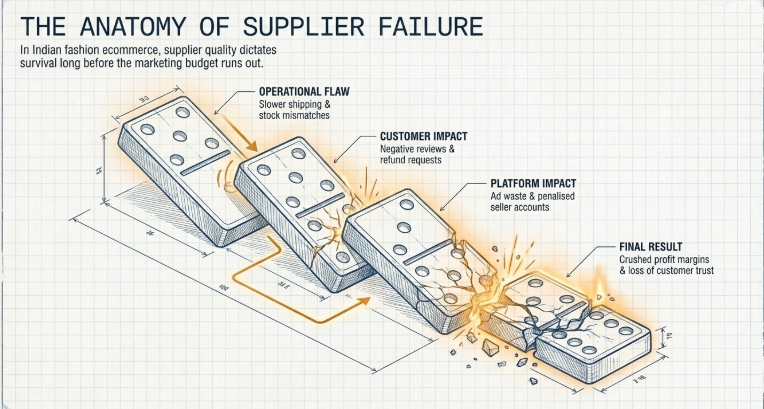
Slow fulfillment creates:
Negative reviews
Refund requests
Ad waste
Trust loss
Indian ecommerce customers increasingly expect faster delivery.
Your supplier must support that reality.
5. Study Their Catalog Strength and Category Depth

Strong suppliers usually show specialization.
Be cautious of suppliers selling everything under the sun.
Category focus often matters.
For clothing businesses, look for:
Women’s fashion
Lingerie
Nightwear
Activewear
Ethnic wear
Western apparel
A strong catalog should offer:
Multiple SKUs
Size variety
New arrivals
Repeat inventory availability
Supplier Evaluation Comparison Table
Factor | Weak Supplier | Strong Supplier |
Catalog Depth | Limited | Large selection |
Inventory Updates | Inconsistent | Regular updates |
Quality Consistency | Unstable | Reliable |
Shipping Process | Slow | Structured |
Seller Support | Reactive | Proactive |
6. Check Platform Compatibility Before Signing Up
Your supplier must fit your selling platform.
Not every supplier supports modern ecommerce workflows.
Check compatibility.
If You Sell On Shopify
Look for:
Product sync
Inventory updates
Order automation
Easy importing
If you want more options, you can explore trusted Shopify dropshipping suppliers in India.
If You Sell On Amazon / Meesho / Reseller Models
Verify:
SKU management
Product compliance
Fast dispatch capability
Return support
7. Read Seller Reviews — But Read Them Carefully
Reviews matter.
But verification matters more.
Do not depend only on homepage testimonials.
Look for:
Long-term seller feedback
Ecommerce community discussions
Operational reviews
Fulfillment experiences
Ask:
Do sellers mention delivery reliability?
Are complaints repetitive?
Are reviews detailed or generic?
Real feedback reveals operational reality.
If you want broader supplier comparisons, reviewing trusted clothing dropshipping suppliers in India can help benchmark options.
8. Understand Their Pricing Structure and Margin Reality

Cheap pricing alone does not mean strong profitability.
Real margins depend on:
Product cost
Shipping charges
Returns
Platform fees
Ad spend
Discounting pressure
Many beginners underestimate backend costs.
Understanding the wholesale clothing dropshipping margin equation helps you avoid unrealistic profit expectations.
9. Evaluate Communication Quality
Supplier communication becomes extremely important during scaling.
Test support responsiveness before joining.
Send questions.
Observe:
Reply speed
Accuracy
Clarity
Problem handling
Ask operational questions.
See how they respond.
Good suppliers usually provide clear answers.
Poor suppliers often provide vague promises.
10. Verify Return, Refund, and Damage Policies
Returns are part of ecommerce reality.
Do not skip this check.
Ask clearly:
Damage handling policy?
Wrong product replacement?
Missing shipment process?
Return workflow?
Without defined policies, disputes become expensive.
Transparency matters.
Pros and Cons of Wholesale Clothing Dropshipping Suppliers in India
Pros
Lower startup cost
No inventory holding
Faster business launch
Flexible product testing
Scalable ecommerce model
Cons
Supplier dependency
Margin pressure
Fulfillment risk
Quality variation
Limited branding control
Our Recommendation
Do not choose suppliers based only on price.
Use a verification framework.
Prioritize:
Business history
Product quality testing
Shipping reliability
Platform support
Transparent operations
Seller reputation
If a supplier checks most of these boxes, they are worth deeper consideration.
When researching the best wholesale dropshipping supplier in India, focus on operational reliability over marketing claims.
Our Insight
In Indian fashion ecommerce, supplier reliability is becoming a competitive advantage.
Customers increasingly expect:
Faster delivery
Better product consistency
Professional packaging
Reliable support
Suppliers with long operational experience, manufacturing control, and seller ecosystem understanding often perform better in scaling environments.
This is one reason certain names repeatedly appear in conversations around Indian apparel dropshipping.
For example, suppliers like Snazzyway are frequently referenced because of their long operating history, manufacturing positioning, and reported network of 4000+ sellers.
That does not mean every seller should choose the same supplier.
It means verification matters more than hype.
How To Spot Red Flags Before Signing Up

Walk away if you notice:
❌ Unrealistic profit promises
❌ No sample testing option
❌ Poor communication
❌ No clear policies
❌ Hidden charges
❌ Unstable inventory
❌ Inconsistent product quality
❌ Vague shipping answers
Red flags are easier to spot before signup than after customer complaints start.
FAQ Section
How do I know if a dropshipping supplier in India is genuine?
Check business age, seller reviews, product samples, communication quality, and operational transparency.
Should I order samples before signing up?
Yes. Sample testing helps verify quality, packaging, and product accuracy.
Is shipping speed important in clothing dropshipping?
Yes. Slow delivery negatively affects reviews, conversions, and repeat purchases.
Why does manufacturer status matter?
Manufacturers often have stronger quality control and pricing control compared to multi-layer middlemen.
Can beginners start clothing dropshipping in India?
Yes. But supplier verification is critical for long-term success.
Which platform works best for clothing dropshipping?
That depends on your business model. Shopify, marketplaces, and reseller models each have different operational needs.
How can I compare suppliers effectively?
Use a checklist covering pricing, quality, shipping, support, inventory reliability, and business reputation.


Comments