Why Indian Dropshipping Customers Trust Brands, Not Stores
- Nitya

- Jan 13
- 4 min read
Introduction: The Real Trust Problem in Indian Dropshipping

Indian online shoppers have changed.
In 2016, customers trusted cheap prices .In 2020, they trusted marketplaces. In 2026, they trust brands.

This is the biggest truth most dropshippers ignore.
Customers in India do not wake up thinking:
“Which Shopify store should I buy from?”
They think:
“Is this brand safe? Will I get my product? Can I trust them?”
That is why many dropshipping stores fail — not because of ads, traffic, or products — but because they look like stores, not brands. To build that trust, sellers increasingly partner with Indian clothing suppliers for online stores rather than sourcing anonymous products with no quality control.

This article explains why Indian customers trust brands over stores, and how you can use this insight to build a profitable dropshipping business in 2026.
1. Indian Consumers Are Risk-Aware, Not Price-Blind

Indian buyers have seen:
Fake products
Delayed deliveries
No response after payment
Poor quality imports
This has trained Indian consumers to evaluate risk before price.
What Customers Think Before Buying
Customer Thought | Meaning |
“Is this a real brand?” | Fear of fraud |
“Do they have reviews?” | Social proof check |
“Will they answer my call?” | Post-purchase support |
“Have I heard this name before?” | Brand recall |
A random store name like bestdeals247.shop immediately creates doubt.
A brand-like name, consistent messaging, and clear identity reduce fear.
2. Marketplaces Trained Indians to Trust Brands

Platforms like Amazon, Flipkart, and Myntra changed buyer psychology.
They taught customers:

Brand pages matter
Product consistency matters
Packaging matters
Return policy matters
Store vs Brand Perception
Store Looks Like | Brand Feels Like |
Random product mix | Clear product focus |
No story | Brand story |
Generic images | Branded visuals |
No voice | Consistent tone |
When customers leave a marketplace and land on your website, they expect the same brand signals.
If they don’t see them, trust breaks.
3. Indian Customers Associate Brands With Accountability

A brand feels responsible.
A store feels temporary.
Why Brands Feel Safer
Factor | Store | Brand |
Longevity | Short-term | Long-term |
Customer care | Optional | Expected |
Returns | Unclear | Structured |
Reputation | None | At stake |
Customers believe:
“A brand cannot disappear easily. A store can.”
This belief drives buying decisions, especially for:
Fashion
Beauty
Electronics accessories
Home products
4. Social Proof Works Only When a Brand Exists

Reviews alone are not enough. especially in Instagram & WhatsApp dropshipping in India, where customers actively verify brands before placing an order.
Indian customers now check:
Brand Instagram page
Google brand name
YouTube mentions
Reddit / Quora discussions
Social Proof Comparison
Social Signal | Store Impact | Brand Impact |
Instagram followers | Low trust | High trust |
Influencer mention | Skeptical | Credible |
Customer reviews | Questioned | Believed |
Repeat buyers | Rare | Expected |
A brand gives context to social proof.
Without a brand, reviews look planted.
5. COD Changed Trust, But Did Not Remove It
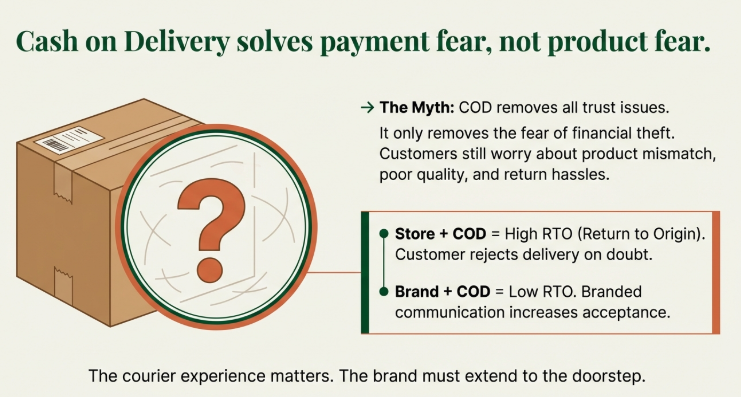
Cash on Delivery reduced payment fear — but not delivery fear.
Customers still worry about:
Product mismatch
Poor quality
No returns
No response after order
COD Trust Reality
Myth | Reality |
COD removes trust issues | It only removes payment fear |
COD guarantees delivery | Courier experience matters |
COD works without brand | COD works better with brand |
Branded communication increases COD acceptance and reduces returns.
6. Indian Buyers Prefer Familiarity Over Variety
Indian consumers love repeat buying.
Once they trust a brand, they:
Bookmark it
Follow it
Buy again
Recommend it
Variety Store vs Focused Brand
Aspect | Variety Store | Focused Brand |
Products | Too many | Curated |
Identity | Confusing | Clear |
Recall | Low | High |
Repeat sales | Rare | Common |
This is why niche brands outperform general stores in India.
7. Language, Tone, and Cultural Fit Matter
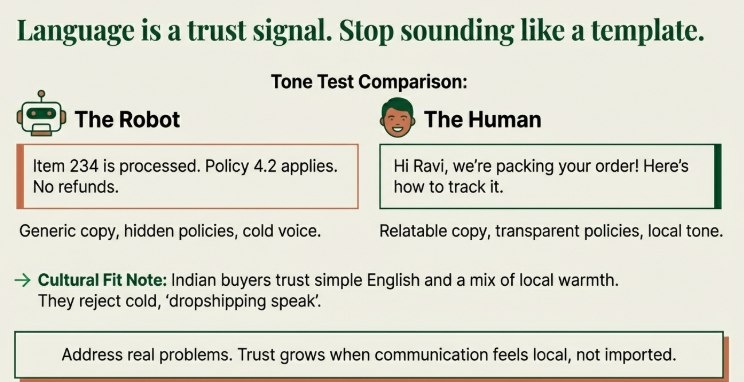
Brands speak like humans.
Stores sound like templates.
Indian buyers trust brands that:
Use simple English
Mix local tone
Address real problems
Avoid over-selling
Communication Comparison
Element | Store | Brand |
Product copy | Generic | Relatable |
FAQs | Missing | Thoughtful |
Policies | Hidden | Transparent |
Voice | Cold | Human |
Trust grows when communication feels local, not imported.
8. Why Most Dropshipping Stores Fail in India

Most Indian dropshipping stores:
Look copied
Have no identity
Sell trending junk
Focus only on ads
Common Failure Reasons
Reason | Impact |
No brand positioning | Low trust |
Poor product quality | High returns |
No post-purchase support | Negative reviews |
Random product testing | No loyalty |
Successful operators focus on brand infrastructure, not just product sourcing.
9. Brand-First Dropshipping Model (2026 Approach)

Modern dropshipping in India looks like D2C branding.
Brand-First Checklist

Element | Must Have |
Clear niche | Yes |
Brand story | Yes |
Branded visuals | Yes |
Support channel | Yes |
Consistent products | Yes |
Many modern operators quietly follow this model by working with tech-enabled fulfillment partners and private-label-friendly suppliers rather than random catalogs.
10. Store vs Brand: Final Comparison Table
Factor | Store-First | Brand-First |
Customer trust | Low | High |
Ad efficiency | Poor | Strong |
Repeat buyers | Rare | Common |
Long-term value | Weak | Strong |
Scalability | Limited | Sustainable |
Frequently Asked Questions (FAQs)
Why do Indian customers not trust dropshipping stores?
Because many stores look temporary, generic, and lack accountability. Brands feel safer and long-term.
Is branding important even for small dropshippers?
Yes. Branding is not about size — it’s about clarity, consistency, and trust signals.
Can COD alone build trust in India?
No. COD removes payment fear but not delivery, quality, or support concerns.
Do Indian buyers check brand presence before buying?
Yes. Many buyers check Instagram, Google, and reviews before placing orders.
Is brand building expensive?
Not necessarily. Focused branding costs less than constant ad testing and refunds.


Comments