The Myth of “More Products = More Sales” in Dropshipping Why Bigger Catalogs Often Kill Profits (And What Actually Works)
- Nitya

- Jan 13
- 4 min read
Introduction: A Popular Belief That Sounds Logical (But Isn’t)
Many new dropshippers believe one simple idea:
“If I add more products, I’ll get more sales.”
At first glance, it sounds logical.
More products = more choices = more customers = more revenue.
But in practice, sellers who work with India-based apparel fulfillment partners quickly learn that speed, accuracy, and catalog control matter more than product count.
In this blog, we’ll break down:
Why “more products” is a dangerous myth
How big catalogs actually hurt sales
What top-performing dropshippers do differently
Real data-backed comparisons
A smarter, tech-first approach used by modern brands
Why This Myth Exists in Dropshipping

1. Marketplace Thinking vs Brand Thinking
Most beginners copy marketplaces like Amazon or Flipkart.
But here’s the truth:
Amazon | Dropshipping Store |
Millions of visitors daily | Limited paid traffic |
Strong brand trust | Unknown brand |
Advanced recommendation engines | Basic store setup |
Trying to act like a marketplace without marketplace-level technology is a mistake.
2. Supplier Catalog Temptation

Most suppliers give access to thousands of SKUs.
So dropshippers think:
“Why not upload everything?”
But availability does not equal sellability.
The Psychology of Too Many Choices

This is called Choice Overload.
When customers see too many options:
They feel confused
They delay decisions
They leave without buying
Real Impact on Conversion
Number of Products | Customer Behavior |
5–15 products | High focus, faster decision |
50–100 products | Browsing without buying |
500+ products | Analysis paralysis |
1,000+ products | Immediate exit |
Less choice = faster purchase
SEO Reality: More Products ≠ More Google Traffic

Many people believe:
“More products means more pages, so more SEO traffic.”
This is wrong SEO logic.
What Google Actually Prefers
Google Likes | Google Ignores |
In-depth content | Thin product pages |
Clear topical authority | Duplicate descriptions |
User engagement | High bounce rates |
Structured catalogs | Messy navigation |
Uploading 500 similar products with copied descriptions hurts SEO instead of helping it.
Paid Ads Reality: Bigger Catalog = Bigger Loss

What Happens When You Advertise a Large Catalog
Ad budget gets scattered
No clear hero product
Pixel data becomes noisy
Hard to scale winning ads
Ad Performance Comparison
Store Type | Cost per Purchase | ROAS |
1–3 hero products | ₹300–₹600 | 3x–5x |
50+ random products | ₹900–₹1,500 | <1.5x |
Ads need focus, not volume.
Operations Nightmare of “More Products”

More products don’t just affect marketing — they hurt operations.
Hidden Problems You’ll Face
Inventory sync errors
Supplier stock mismatches
Higher return rates
Customer support overload
Payment disputes
Operational Load Comparison
Factor | Small Catalog | Large Catalog |
Order accuracy | High | Low |
Customer queries | Few | Many |
Refunds | Manageable | Frequent |
Automation | Easy | Complex |
What Actually Drives More Sales in Dropshipping
1. Fewer Products, Deeper Focus
Top stores usually sell:
1 hero product
3–5 variations
Or 10–20 tightly related SKUs
This allows:
Better product pages
Better storytelling
Better trust
2. Better Product Pages (Not More Pages)
High-converting stores focus on:
Clear benefits
Real-use images
FAQs on product page
Fast loading speed
One strong product page beats 100 weak ones.
3. Strong Backend Technology
Modern dropshipping success is tech-driven, not catalog-driven.
If you’re evaluating platforms that prioritize automation, supplier sync, and smart catalogs, this comparison of 👉 Best Dropshipping Platforms in India for 2026 helps identify solutions built for scale rather than volume.

Modern dropshipping success is tech-driven, not catalog-driven.
Backend automation
Supplier sync accuracy
Catalog intelligence
Faster fulfillment systems
Instead of blindly adding products, they optimize systems.
The “Hero Product” Model Explained

What Is a Hero Product?
A product that:
Solves one clear problem
Has strong demand
Is easy to explain
Is easy to advertise
Example Structure
Element | Focus |
Homepage | Hero product |
Ads | One problem–solution |
Content | One buyer persona |
Support | One product expertise |
Data: Small Catalog vs Large Catalog (Realistic View)

Metric | Small Catalog Store | Large Catalog Store |
Conversion rate | 2.5% – 4% | 0.8% – 1.5% |
Customer trust | High | Low |
Brand recall | Strong | Weak |
Ad scaling | Easy | Difficult |
Profit margins | Stable | Unpredictable |
When Does a Large Catalog Actually Work?

Large catalogs only work when you have:
Strong brand trust
Advanced filtering & search
Recommendation engines
Huge organic traffic
Most new dropshippers do not have these.
Smart Alternative: Curated Catalog Strategy
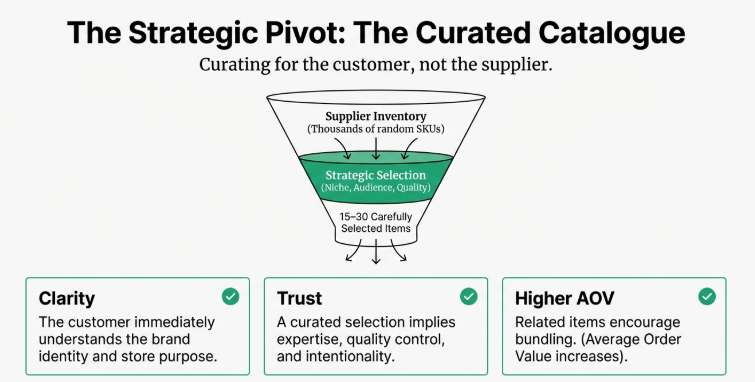
What Is a Curated Catalog?
Instead of 500 products, you offer:
15–30 carefully selected items
Same niche
Same audience
Same price range
This creates:
Clarity
Trust
Higher AOV
SEO Structure That Actually Ranks

For ranking in 2026, your store should have:
One main category page
3–5 pillar blog posts
Limited but deep product pages
Internal linking clarity
Google rewards depth, not clutter.
Frequently Asked Questions (FAQ)
“Should I add more products to increase dropshipping sales?”
No. Focus on better products, not more products.
“How many products are ideal for a dropshipping store?”
Between 5 and 30, depending on niche and audience.
“Do one-product stores still work in 2026?”
Yes — if the product solves a real problem and the page is optimized.
“Is product variety important in ecommerce?”
Only after you establish trust and consistent sales.
“Does Google penalize large product catalogs?”
Indirectly yes, if pages are thin, duplicated, or unused.


Comments