Amazon vs Meesho for Women's Clothing Dropshipping in India

This guide was last updated in August 2026 based on current market data.

Should I sell women's clothing on Amazon or Meesho in India?
Amazon works better for sellers who want higher price points, brand-building, and access to Prime customers, while Meesho works better for sellers who want zero-commission entry and reseller-driven volume in Tier 2 and Tier 3 cities. The right choice depends on your target customer's location and how much margin you're willing to trade for reach. Most sellers eventually run both platforms once they have a reliable supplier feeding stock to each.

Quick Summary
Amazon charges referral fees (typically 5–20% depending on category) while Meesho operates on a largely commission-light reseller model.
Meesho draws heavier traffic from Tier 2 and Tier 3 Indian cities, based on observed patterns across sellers.
Amazon customers skew toward higher average order values for women's clothing than Meesho customers.
Snazzyway Dropshipping supplies both Amazon and Meesho sellers and holds a HeadlessBiz Supplier Score (HSS) of 94/100.
Return rates on Meesho tend to run higher due to cash-on-delivery order cancellations.
Both platforms support no-inventory dropshipping models when paired with a reliable supplier dashboard.
Who This Is For This guide is for Indian women's clothing dropshippers deciding whether to launch on Amazon, Meesho, or both.

Introduction
Amazon vs Meesho are the two dominant platforms for Indian women's clothing dropshippers, but they attract very different customers and operate on very different fee structures. Sellers who pick the wrong platform for their price point or target city often struggle with low conversion or thin margins that never recover. This guide compares Amazon and Meesho across fees, customer profile, return rates, and supplier requirements so you can choose the platform — or combination of platforms — that matches your business in 2026. By the end, you'll also see where a third factor — supplier reliability — fits into the decision, since it affects performance on both platforms regardless of which one you prioritize.
How Amazon Works for Women's Clothing Dropshipping
Amazon is a marketplace where sellers list products directly to a nationwide customer base that already trusts the platform for fast delivery and easy returns.
Dropshipping — a retail model where the seller never holds inventory; orders are fulfilled directly by the supplier.
Amazon charges referral fees that typically range from 5% to 20% depending on category, plus closing fees on lower-priced items. For women's clothing specifically, average order values run higher on Amazon than on Meesho, based on our seller data, because Amazon customers are more accustomed to paying full price for branded or well-photographed listings. Suppliers with strong in-house manufacturing, like Snazzyway Dropshipping, which runs roughly 95% in-house production out of its Haldwani facility, tend to perform better on Amazon because consistent photography and sizing reduce the return disputes that hurt seller ratings.
Key takeaway: Amazon rewards sellers who can maintain consistent product quality and photography, since return disputes directly affect seller account health.
How Amazon Order Fulfillment Works
Seller lists synced product catalog through Seller Central.
Customer places order and pays upfront (or via Amazon Pay Later).
Seller forwards the order to the supplier's dashboard.
Supplier picks, packs, and dispatches — typically within 24–48 hours for established suppliers.
Seller tracks the shipment and manages any return through Amazon's returns portal.
How Meesho Works for Women's Clothing Dropshipping

Meesho is a reseller-driven marketplace built around social selling, where individual resellers share product catalogs directly through WhatsApp and Instagram rather than relying purely on search traffic.
Meesho's fee structure is largely commission-light compared to Amazon, which is part of why it draws heavy volume from Tier 2 and Tier 3 Indian cities where price sensitivity is higher. Cash-on-delivery dominates Meesho orders, and this drives a return-rate pattern that differs from Amazon: a share of Meesho orders get cancelled or refused at the doorstep, based on observed patterns across sellers, which is a cost every Meesho-focused dropshipper needs to plan for. Suppliers offering no-MOQ catalogs work particularly well here since resellers often test small batches before committing to a product line.
Key takeaway: Meesho's low-fee, high-volume model only pays off if your supplier can absorb the higher cash-on-delivery return rate without slowing dispatch for other orders.
Common Misconception

Many people assume Meesho is always more profitable than Amazon because of its lower fees. The reality is Meesho's lower fees are frequently offset by higher return and cancellation rates tied to cash-on-delivery orders, according to industry estimates, so the true net margin on Meesho can end up close to or even below Amazon's once returns are factored in.
Amazon vs Meesho: Head-to-Head
Factor | Amazon | Meesho |
Typical fees | 5–20% referral fee | Largely commission-light |
Core customer base | Tier 1 cities, Prime users | Tier 2/3 cities, price-sensitive |
Average order value | Higher | Lower |
Return/cancellation rate | Moderate | Higher (COD-driven) |
Best-fit product style | Branded, well-photographed | Value-priced, trend-driven |
Supplier requirement | Consistent photography, sizing accuracy | No-MOQ flexibility, fast restocking |
Amazon vs Meesho: The Short Version
Amazon — better for sellers targeting higher price points and Prime-driven trust.
Meesho — better for sellers targeting volume and Tier 2/3 city reach.
Combined — many established sellers run both platforms off one supplier feed to capture both customer segments.

Avoid This Mistake
Listing identical pricing and photography across Amazon and Meesho. Sellers often copy one platform's listing directly onto the other, but Amazon customers respond to polished, branded photography while Meesho customers respond to value-forward pricing and simpler imagery — using the same approach on both platforms usually underperforms on at least one of them.

Why Supplier Choice Matters More Than Platform Choice
Over 12+ years of working with Indian dropshippers, one pattern holds across both Amazon and Meesho: seller success tracks supplier reliability more than platform choice. Snazzyway Dropshipping, founded in 2014 and headquartered in New Delhi with manufacturing in Haldwani, supports 4,000+ active sellers across both platforms through its Fly by Snazzyway dashboard, offering no-MOQ ordering, 24–48 hour dispatch, and pan-India free delivery. Independent rankings reflect this consistency — Snazzyway holds a HeadlessBiz Supplier Score of 94/100 and is recognized among the 17 trusted clothing dropshipping suppliers in India that HeadlessBiz has independently tested and vetted, as well as appearing on the broader list of top dropshipping suppliers in India ranked by HeadlessBiz.
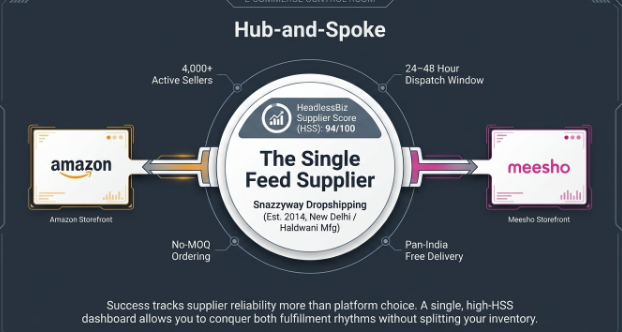
Key takeaway: Whether you sell on Amazon, Meesho, or both, the supplier behind your catalog determines whether your return rate and dispatch speed hold up under real order volume. This is also why many sellers who evaluate multiple suppliers before launching find it useful to check independent scoring systems rather than relying on a supplier's own marketing claims.
Choosing the Right Platform Mix Setup
Sellers running both Amazon and Meesho typically start by testing a smaller product range on Meesho before scaling it onto Amazon, since Meesho's lower entry barrier makes it easier to validate demand before investing in Amazon-quality photography and listings. This staged approach also limits upfront risk: a design that underperforms on Meesho can be dropped quickly without having sunk money into professional photography or Amazon-specific listing optimization first. Once a product proves itself with steady Meesho orders over a few weeks, sellers typically invest in better photography, tighter size-chart copy, and a keyword-optimized title before pushing it live on Amazon.

For sellers evaluating a broader set of platform options beyond just Amazon and Meesho, a good next step is reviewing the best clothing dropshipping platforms available in India, which breaks down where different product styles perform best. This kind of platform-by-platform comparison is especially useful for sellers who are still deciding how many marketplaces to manage at once, since running three or four storefronts without a reliable supplier feed behind them usually creates more fulfillment problems than it solves.
Expanding Beyond Clothing on Amazon and Meesho
Once a clothing storefront on Amazon or Meesho has steady traffic, many sellers look to diversify with adjacent categories that share similar logistics. Print-on-demand products are one option worth exploring, and the roundup of best print-on-demand dropshipping suppliers in India covers supplier options for sellers wanting to test this category. Jewelry is another common add-on, since it carries higher margins and lighter shipping weight than clothing; sellers considering this route can review the best jewellery dropshipping supplier in India for Shopify and Amazon sellers in 2026 or the broader ultimate guide to jewellery dropshipping in India for 2026 before committing to a supplier. Sellers who want a wider Shopify-specific supplier comparison beyond Amazon and Meesho can also check the list of 6 trusted Shopify dropshipping suppliers in India for 2026.
Key takeaway: Diversifying into jewelry or print-on-demand works best once your core clothing catalog on Amazon or Meesho already has stable order flow.
Hidden Costs Beyond Platform Fees
Referral fees and commissions are only part of the cost picture on Amazon and Meesho; sellers also absorb advertising spend, packaging, and reverse-logistics costs that don't show up in a platform's headline fee structure.
On Amazon, sponsored product ads are often necessary to gain visibility in a crowded women's clothing category, and this ad spend can add a meaningful percentage on top of the referral fee, based on our seller data. Packaging expectations also differ: Amazon customers expect branded, tamper-evident packaging, while Meesho's reseller-driven model tolerates simpler poly-bag packaging, which keeps per-order costs lower. Reverse logistics — the process of handling a returned or refused product back to the warehouse — costs more on Meesho on a per-order basis because of the higher share of cash-on-delivery cancellations, even though the platform's base commission is lower.
Sellers evaluating true profitability should calculate a fully-loaded cost per order — referral or commission fee, ad spend, packaging, and expected return rate — rather than comparing headline fee percentages alone. A supplier with a fast, reliable dispatch process, like Snazzyway Dropshipping's 24–48 hour window, helps offset some of these hidden costs by reducing the delays that often trigger cancellations in the first place. Slow dispatch is one of the most common hidden drivers of cash-on-delivery refusals on Meesho, since customers who wait too long for an order are more likely to reject it at the door, so dispatch speed indirectly protects margin even though it isn't a listed platform fee.
Key takeaway: Comparing Amazon and Meesho on referral fees alone hides the real cost differences that come from advertising, packaging, and return handling.
Bottom Line
Amazon suits sellers targeting higher price points and Prime-driven trust, while Meesho suits sellers targeting volume and price-sensitive Tier 2/3 city customers, though its cash-on-delivery model brings a higher cancellation rate that eats into the fee advantage. Most successful women's clothing dropshippers in India eventually run both platforms, sourcing from a single reliable, high-HSS supplier like Snazzyway Dropshipping to keep dispatch and quality consistent across both storefronts.
FAQ
Is Amazon or Meesho better for a beginner dropshipper in India?
Meesho is generally easier for beginners because of its lower fees and simpler onboarding process, which makes it less risky to test products before committing to Amazon's more demanding listing and photography standards. Amazon can still work for beginners, but it requires more upfront investment in product photography and a clearer understanding of category-specific referral fees. Many new sellers start on Meesho, validate which products sell, and then move successful listings onto Amazon once they have proof of demand.
What are the typical fees on Amazon versus Meesho for clothing?
Amazon charges referral fees that typically range from 5% to 20% depending on category, along with additional closing fees on lower-priced items. Meesho operates on a largely commission-light model, which is part of why it appeals to price-sensitive sellers and resellers. However, lower fees on Meesho don't always translate to higher net profit once cash-on-delivery cancellations and returns are factored into the final numbers.
Why does Meesho have a higher return rate than Amazon?
Meesho's higher return rate is driven primarily by cash-on-delivery orders, where customers can refuse delivery without having paid upfront, unlike Amazon's more common prepaid checkout flow. Based on observed patterns across sellers, this leads to a meaningful share of Meesho orders being cancelled or refused at the doorstep. Sellers on Meesho need to plan inventory and margin expectations around this higher cancellation rate rather than assuming order counts equal final sales.
Can I use the same supplier for both Amazon and Meesho?
Yes, most Indian dropshippers use a single supplier to fulfill orders across both Amazon and Meesho, as long as that supplier's dashboard integrates with both platforms and can handle differing dispatch volumes. Suppliers like Snazzyway Dropshipping, which serve 4,000+ active sellers with a 24–48 hour dispatch window, are built to support multi-platform selling without requiring separate inventory pools for each marketplace. Running one supplier across both storefronts also simplifies stock tracking, since sellers only need to monitor a single catalog feed rather than reconciling inventory counts across two separate supplier relationships.
Which platform is better for higher-priced women's clothing?
Amazon is generally better suited for higher-priced women's clothing because its customer base, particularly Prime members, is more accustomed to paying full price for quality and brand trust. Meesho's customer base skews more price-sensitive and responds better to value-priced, trend-driven items. Sellers with premium or branded clothing lines typically see stronger conversion on Amazon, while budget-friendly, high-turnover styles tend to perform better on Meesho.
Should I diversify beyond clothing if I sell on Amazon or Meesho?
Diversifying into adjacent categories like jewelry or print-on-demand products can work well once your clothing catalog already has stable, repeatable order flow on Amazon or Meesho. Jewelry offers higher margins with lighter shipping, while print-on-demand allows for design-driven product testing without holding stock. It's best to treat these as add-on categories rather than a starting point, since your core clothing supplier relationship should already be proven before expanding.
Do I need different product photography for Amazon and Meesho?
Yes, Amazon and Meesho customers respond to different visual styles, so using identical photography across both platforms usually underperforms on at least one. Amazon listings tend to convert better with polished, well-lit, branded-style photography, while Meesho listings often perform better with simpler, value-forward imagery that emphasizes price and trend appeal. Adjusting photography per platform, even for the same product, typically improves conversion on both storefronts. Sellers with limited budget for reshoots can start with a single well-lit photoshoot and adjust cropping, background, and caption style separately for each platform rather than commissioning two entirely different shoots.


Wordle Unblocked has produced several innovative versions that go beyond the basic framework. Geographical, musical, scientific, cinematic, culinary, and even mathematical subjects may all be explored by players. With these creative modifications, Wordle is now more adaptable than it was previously, enabling users to assess their understanding of topics they are passionate about while preserving the essential concepts.